150x150.png)
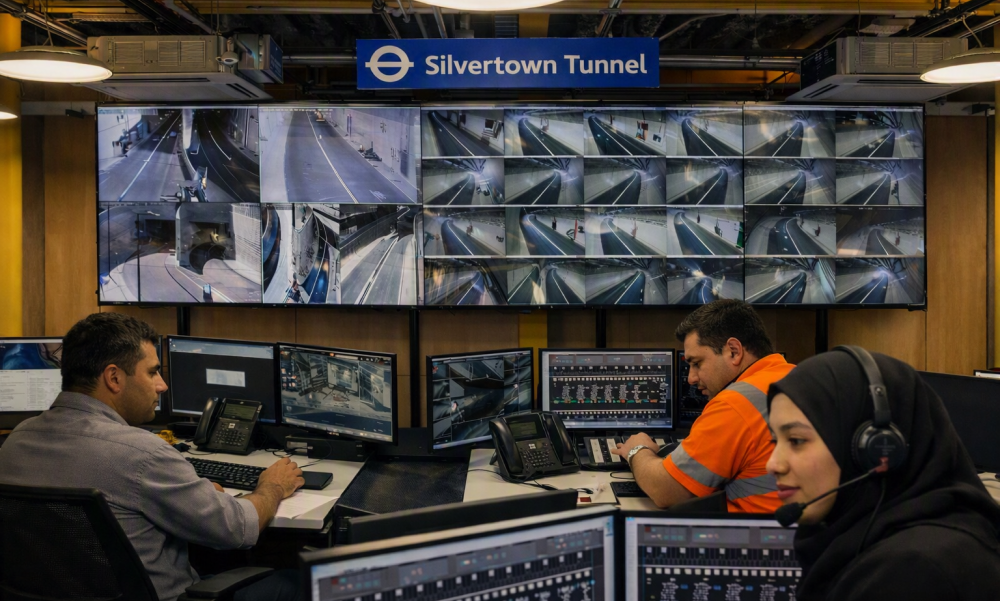
There are moments in the life of a transport network when progress becomes visible not through grand announcements but through the steady accumulation of evidence. London is in one of those moments now. The city’s traffic systems are being reshaped by a combination of infrastructure, policy and technology, and the most interesting part of the story is not the headlines but the metrics that sit beneath them. They reveal a network that is learning, adapting and responding in ways that would have been impossible even a decade ago. Three developments in particular show how far the capital has travelled and how deeply digital capability now underpins its mobility strategy.
The first is the Silvertown Tunnel’s performance data. For years, the debate around new river crossings has been dominated by questions of equity, congestion and environmental impact. The opening of Silvertown brought all of those questions back to the surface, but the first full year of operation has delivered something rare in transport: clear, measurable improvement. Peak northbound journeys approaching Blackwall are now nearly sixty per cent faster in the morning and almost fifty per cent faster in the evening. Nitrogen dioxide levels have fallen by seventeen per cent. These are not abstract projections. They are real numbers drawn from real journeys, captured through a network of sensors, counters and monitoring systems that feed directly into TfL’s analytical platforms.
The significance of this is not simply that the tunnel works. It is that London can now prove it works. The city’s ability to measure change at this level of detail reflects a quiet revolution in how traffic is monitored. The combination of roadside detection, connected vehicle data, bus telemetry and air quality sensors creates a picture of network behaviour that is both immediate and trustworthy. It allows TfL to understand not just where congestion has eased but how traffic has redistributed, how bus reliability has shifted and how localised emissions have changed. It also provides the foundation for future optimisation. With this level of insight, signal timings, bus priority and corridor management can be adjusted with confidence rather than intuition. The tunnel is a piece of physical infrastructure, but its impact is being amplified by digital intelligence.
The second development is the borough level rollout of TfL’s congestion and roadworks strategy. The strategy itself was published in January, but the real story is unfolding now as boroughs adopt the measures and begin to apply them on their own streets. Camden, Enfield, Lambeth and Merton are already live, and more than twenty boroughs are progressing applications. The expansion of the lane rental scheme is central to this. It changes the economics of roadworks by encouraging utility companies to minimise disruption and plan more intelligently. The technology behind it is less visible than the cones and barriers on the street, but it is just as important. TfL’s digital permitting systems, mapping tools and works coordination platforms allow the city to track activity in real time, identify conflicts and intervene before problems escalate.
This is where the value of accurate metrics becomes clear again. The ability to quantify the impact of roadworks on bus reliability, pedestrian movement and general traffic flow gives boroughs a stronger basis for decision making. It also creates accountability. When a works programme overruns or a poorly planned closure causes unnecessary congestion, the data shows it. When a well coordinated scheme keeps disruption to a minimum, the data shows that too. The strategy is not simply a policy document. It is a framework supported by digital tools that allow London to manage its streets with far greater precision.
The third strand is the continuing deployment of AI enhanced traffic management across the capital. This is not a new announcement, but it is a live and evolving story. TfL’s upgrade of its Yutraffic Fusion control system, the expansion of VivaCity AI sensors and the push to bring bus priority optimisation to all signals on bus routes are all part of a wider shift towards adaptive, data driven control. The technology is not replacing human judgement. It is strengthening it. Operators in the traffic management centre now have access to richer classification, more accurate detection and more reliable predictions. They can see not just what is happening, but what is likely to happen next.
The most interesting part of this transition is how it changes the rhythm of the network. Although London had one of the most advanced SCOOT Urban Traffic Control systems, it had reached a point where the complexity and volume of traffic largely resulted in reliance on fixed plans, periodic reviews and reactive intervention. AI supported control allows for continuous adjustment. When pedestrian volumes rise unexpectedly, timings can be altered. When bus bunching begins to form, priority can be increased. When a corridor starts to saturate, alternative routes can be supported. The system becomes more responsive because it is more aware, sensors provide the raw material, algorithms interpret it and the operators apply it. The result is a network that behaves more like a living system than a mechanical one.
Taken together, these three developments show a city that is moving beyond the old model of transport management. London is no longer relying on periodic studies, manual counts and retrospective analysis. It is using technology to understand itself in real time. The Silvertown Tunnel data shows how infrastructure can be evaluated with clarity. The borough level rollout shows how policy can be implemented with precision. The AI enhanced control shows how operations can be refined with intelligence. Each strand reinforces the others. The tunnel changes traffic patterns. The borough strategy manages the consequences. The AI systems optimise the flow.
There is a deeper point here about trust. Transport systems depend on public confidence. People need to believe that decisions are being made fairly, that investments are delivering value and that the network is being managed responsibly. Technology helps to build that confidence because it provides evidence. It allows TfL to demonstrate improvement rather than simply claim it. It allows boroughs to justify decisions rather than defend them. It allows operators to intervene with authority rather than hope. The metrics are not the story, but they make the story possible.
London’s transport network is still complex, still unpredictable and still subject to the pressures of a growing city. But it is becoming more measurable, more adaptable and more intelligent. The progress being made across these three fronts shows a system that is learning how to use technology not as an accessory but as an essential part of its identity. The capital is not just moving people. It is understanding how it moves them. That is the real transformation, and it is only just beginning.
Click the buttons below to see more articles:
See all ArticlesIndustry InsightEventsITS Thought LeadershipITS Educational