
Delegates spent the fourth day of the 32nd ITS World Congress in Gangneung, moving between technical sessions, exhibition halls, live demonstrations and international networking events. Artificial intelligence, cooperative ITS, connected and automated mobility, data governance and digital infrastructure remained dominant themes, yet a common thread linked almost every discussion. The challenge is no longer discovering what technology can do. The challenge is delivering it consistently, securely and at scale.
That shift from innovation to implementation was evident throughout Gangneung, a city that continues to use the Congress as a living showcase for intelligent transport. Visitors experienced first-hand examples of autonomous Masil buses, AI-supported traffic signal management and connected mobility services that have become embedded within the daily lives of residents rather than existing as isolated pilot projects. The city's deployment model has attracted considerable interest from transport authorities looking to understand how intelligent infrastructure can move beyond demonstration status and become part of everyday urban operations.
For UK and European delegates, day four also brought a series of significant moments that highlighted both the leadership role Europe continues to play within the sector and the growing momentum building towards the next ITS World Congress in Birmingham.
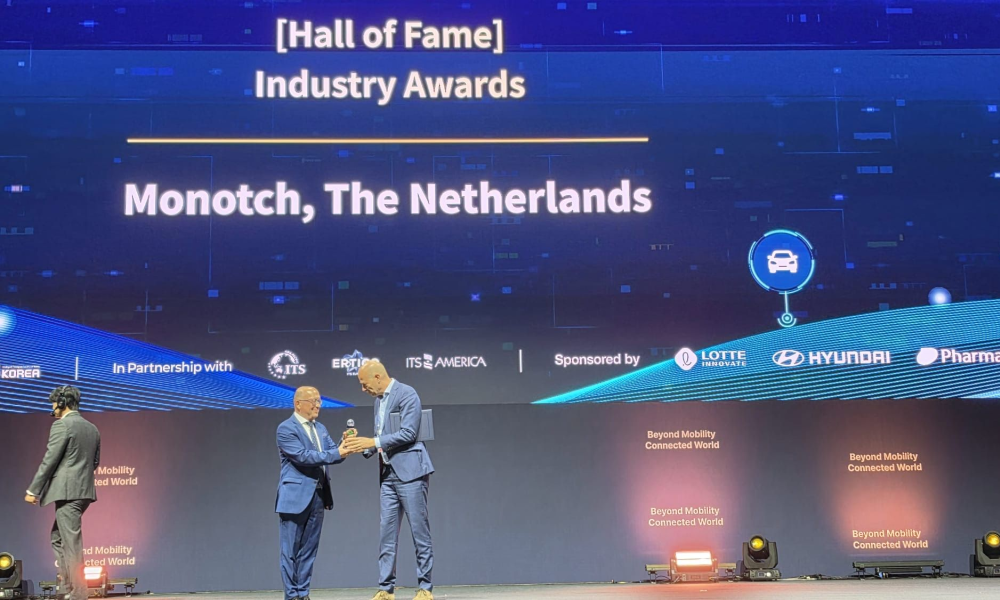
One of the day's headline announcements came through the EMEA ITS Hall of Fame Awards, which recognised outstanding contributions from academia, local government and industry.
The prestigious Lifetime Achievement Award was presented to Professor Phil Blythe CBE, Professor at Newcastle University and former Chief Scientific Adviser to the UK Department for Transport. The award recognised more than three decades of pioneering work that has helped shape the development of intelligent transport systems both in the UK and internationally. Throughout his career, Professor Blythe has consistently bridged the gap between research and deployment, helping transform innovative concepts into practical transport solutions that continue to influence policy, strategy and implementation today.
The Local Government Award was presented to the City of Leuven in Belgium, recognising its leadership in creating a genuinely intelligent and sustainable urban mobility ecosystem. Leuven has become one of Europe's most compelling examples of how cities can integrate autonomous shuttles, intelligent cycling infrastructure, smart traffic management and connected mobility services into a coherent strategy that improves accessibility, sustainability and quality of life. Its achievement served as a timely reminder that successful intelligent transport deployments are increasingly measured not by technology alone, but by their ability to improve outcomes for communities.
The Industry Award went to Dutch company Monotch and its founder Menno Malta, recognising the company's contribution to connected mobility through open and interoperable data exchange platforms. Unsurprisingly, the announcement generated considerable attention throughout the Congress, not least because Monotch's work aligns closely with many of the themes dominating discussions across Gangneung this week.
The recognition was driven largely by the continuing international deployment of TLEX 2.0, Monotch's Traffic Live Exchange platform. Acting as a carrier-neutral data exchange backbone, the platform enables road operators, traffic management centres, infrastructure owners and mobility service providers to exchange information securely and in real time.
While data exchange may appear a highly technical subject, its significance is difficult to overstate. Modern mobility increasingly depends upon vehicles, roadside infrastructure and digital services sharing reliable information instantly. Signal phase and timing data, roadworks information, incident alerts and cooperative safety messages all rely upon trusted exchange mechanisms. Platforms such as TLEX are helping create the digital foundations upon which connected transport ecosystems are being built.
The award also reflects a broader industry transition. Across many sessions in Gangneung, speakers highlighted an accelerating movement away from closed proprietary ecosystems towards open architectures capable of supporting collaboration between multiple stakeholders. Interoperability is becoming more than an aspiration. It is rapidly becoming a necessity.
That emphasis on cooperative mobility could also be seen in demonstrations taking place at the LG Electronics stand, where delegates were given an insight into future safety platforms designed to support next-generation connected and automated vehicles.
LG's approach combines Vehicle-to-Everything communications with Vehicle-to-Network connectivity, creating multiple pathways through which vehicles can receive and distribute safety-critical information. The underlying challenge is familiar to transport engineers worldwide. Conventional Advanced Driver Assistance Systems rely heavily on cameras, radar and lidar, all of which can be limited by physical visibility. Blind junctions, adverse weather conditions, parked vehicles and dense urban environments can obscure potential hazards until it is too late.
By integrating direct V2X communication with cloud-based connectivity, LG is seeking to create a more resilient safety framework capable of detecting hazards beyond the immediate field of view. Particularly notable was the inclusion of vulnerable road users within the system architecture, allowing information from pedestrian devices and roadside infrastructure to contribute to earlier warnings and safer road environments.
These developments are highly relevant to European discussions surrounding Euro NCAP assessment programmes and future safety requirements. Cooperative safety systems are increasingly viewed as a vital complement to traditional sensor-based approaches, particularly as connected mobility moves closer to large-scale implementation.
Away from individual technologies, another recurring theme throughout day four was the growing need for international alignment. Delegations from Europe, Asia and North America repeatedly returned to questions surrounding interoperability, cybersecurity, data sovereignty and cross-border operation.
As connected mobility deployments become increasingly international, differing technical standards and governance frameworks represent a significant challenge. Vehicles crossing national borders cannot rely on incompatible systems, while infrastructure operators need confidence that security and data protection principles are being applied consistently.
Many delegates observed that European experience in developing cooperative ITS corridors, common standards and cross-border deployment frameworks places the region in a strong position to contribute to these discussions. The lessons learned from two decades of European ITS deployment are becoming increasingly relevant to global markets now entering similar stages of maturity.
That spirit of international cooperation was perhaps most evident during the Three Region Cocktail Reception, where attention began turning towards the future and the next gathering of the global ITS community. A major announcement during the event saw ERTICO officially launch the Call for Contributions for the ITS World Congress 2027 in Birmingham. The moment represented far more than the opening of a submissions process. It marked the beginning of the next chapter in the ongoing development of intelligent transport systems worldwide. ERTICO Chairman Dr Angelos Amditis and Chief Executive Joost Vantomme thanked delegates, partners and host organisations while inviting researchers, policymakers, industry experts and transport professionals to help shape the Birmingham programme. Strong recognition was given to the host partnership involving Transport for West Midlands, the West Midlands Combined Authority, the Department for Transport, ITS UK and LCRIG, underlining the significant UK commitment behind the event.
The themes selected for the 2027 programme reflected many of the conversations dominating Gangneung this week: Trustworthy and Resilient Systems, Next Generation ITS, Connected and Integrated Services, and Deploying ITS at Scale.
Collectively, those four pillars could almost serve as a summary of day four itself.
Questions of trust, resilience and security underpin discussions about connected infrastructure. Next-generation ITS continues to drive advances in automation, artificial intelligence and cooperative mobility. Integrated services remain central to improving multimodal journeys and user experience. Meanwhile, deployment at scale has arguably become the defining challenge facing the entire sector.
Importantly, Birmingham intends to bring together not only researchers and technology developers, but also practitioners responsible for implementation. Through technical papers, research papers, special interest sessions and a newly introduced poster format, organisers are seeking to create a platform where experience, evidence and practical lessons can be shared openly. That ambition resonated strongly with the mood across Gangneung on day four.
Whether examining the achievements of Professor Phil Blythe, the urban mobility leadership demonstrated by Leuven, the award-winning data exchange ecosystem developed by Monotch, the cooperative safety innovations showcased by LG Electronics or the operational deployments spread throughout the host city itself, a consistent message emerged.
The future of intelligent transport will not be defined solely by technological breakthroughs. Success will depend upon collaboration, interoperability, trust and the ability to translate innovation into practical outcomes that make transport safer, cleaner, more efficient and more accessible.
As the Congress moves towards its conclusion, Gangneung has demonstrated that the industry is entering a new phase of maturity. The focus is increasingly on deployment rather than demonstration, integration rather than isolation, and measurable outcomes rather than theoretical potential. For UK and European delegates, day four offered an encouraging glimpse of what comes next. The connected future is no longer a distant aspiration. It is being built today, and the journey now continues towards Birmingham in October 2027.
Click the buttons below to see more articles:
See all ArticlesIndustry InsightEventsITS Thought LeadershipITS Educational