150x150.png)
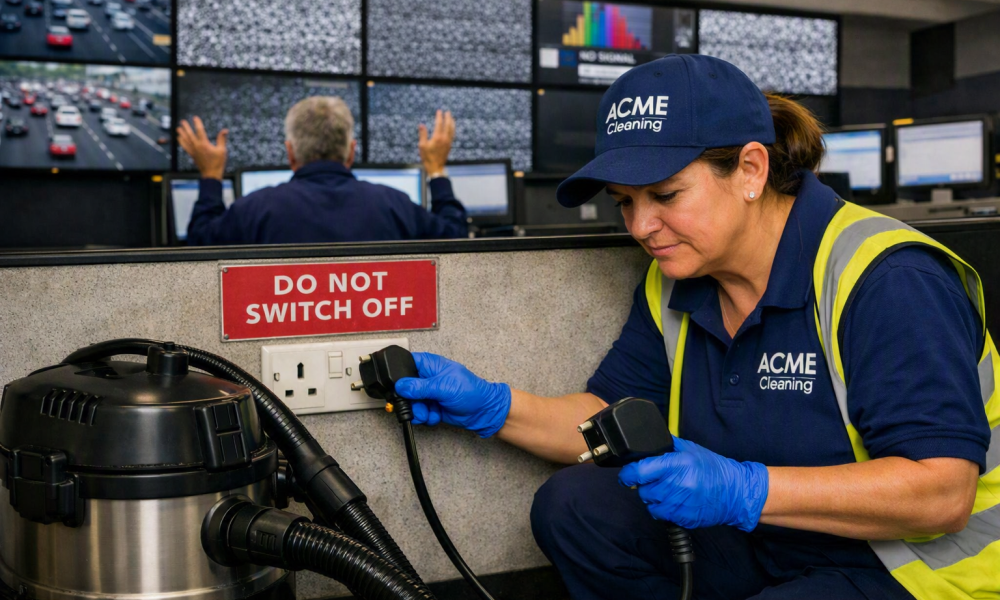
The recent power failure at Network Rail’s Manchester operations centre was described as a rare event, yet its consequences were anything but minor. A short interruption in a single building rippled across the Northwest, halting trains, stranding crews and leaving passengers facing hours of uncertainty. The incident has already prompted questions about resilience, centralisation and investment within the rail sector. It also offers a timely warning for the Intelligent Transport Systems community, because the vulnerabilities exposed in rail operations are not confined to rail. They echo across every mode that relies on digital control, from highways to tunnels to bridges, and especially within the increasingly complex world of Urban Traffic Control.
The outage itself was brief. A local power cut, resolved within ninety seconds, struck the Manchester Rail Operating Centre, one of twelve high tech hubs that now manage signalling and communications across Britain’s railway. These centres replaced hundreds of older signal boxes, consolidating control into fewer, more sophisticated locations. The logic was clear. Modern railways require modern systems, and centralisation promised efficiency, consistency and improved oversight. Yet the incident revealed the fragility that can accompany such consolidation. Although power returned quickly, some communications systems did not respond as expected. They required reconfiguring and, in some cases, replacing. Signalling was affected, trains were stopped and the network entered a slow, painstaking recovery.
The rail network is a tightly choreographed system. Trains run to precise timetables, crews are positioned strategically and assets move in patterns that depend on predictability. When signalling falters, the choreography collapses. Trains end up in the wrong places, crews are displaced and the knock-on effects spread far beyond the initial fault. The Manchester outage demonstrated how a short disruption can become a long operational challenge. It also highlighted how digital systems, even those with backups, can behave unpredictably when stressed.
Intelligent Transport Systems face similar risks, with cities depending on coordinated traffic signals, sensor networks, CCTV feeds, journey time systems and incident management platforms. These systems are increasingly being rationalised, being brought together to streamline their operation and are often housed in the cloud. The logic is the same. Centralisation promises efficiency, better data integration and improved decision making. Yet the Manchester incident shows that this can also create single points of vulnerability. A transient fault that takes down a key systems element, such as part of the communications network, can affect an entire region. A failure in one system can cascade across others. A brief outage can become a citywide disruption.
The first lesson for the ITS sector is the need to understand how digital dependencies behave under stress. The rail outage was not caused by a catastrophic failure. It was caused by a short interruption that exposed weaknesses in how systems recovered. Complex ITS deployments, such as Urban Traffic Control centres, must consider how their systems respond to sudden power loss, network interruptions or unexpected restarts. It is not enough to have a plan. Those operational procedures must be tested, rehearsed and proven to recover full-operational capability predictably. A recovery that fails to initialise correctly is a liability.
The second lesson is the importance of designing ITS systems so that resilience is built into every layer of equipment and every part of the operational architecture. Rail experts have questioned the wisdom of concentrating signalling and communications into a small number of centres, yet the deeper issue is how each component behaves when stressed. Modern traffic control rooms typically rely on cloud-based servers, shared databases and integrated platforms, but they also depend on roadside controllers, sensors, communications links and power supplies that vary in age, capability and reliability. A fault in any one of these elements can influence signal plans, congestion management, incident response and public information. The ITS sector must recognise that resilience is achieved through careful design across the entire system, even though this can be difficult when equipment ranges from cutting edge digital devices to legacy assets that were never intended to operate within complex, interconnected networks.
The third lesson relates to operational fallbacks. When rail signalling failed, trains stopped. Recovery required manual intervention, replacement parts and careful rebooting. Roads face similar challenges when digital systems fail. Traffic signals can revert to local operation, but their effectiveness will only be achieved if their contingency timings and plans within each traffic signal controller is maintained with up-to-date data. Incident response can revert to radio communication, but only if it is available and staff are trained to use it. Diversion routes can be activated manually, but only if they are documented and rehearsed. The ITS sector must ensure that analogue fallbacks remain viable. Digital sophistication is valuable, but it must never erase the ability to operate manually when required.
The fourth lesson is about staffing and resourcing. Rail engineers have already raised concerns about funding pressures and job cuts. They question whether there are enough staff to maintain systems, check supplies and respond to faults. Urban Traffic Control centres face similar pressures. Budgets are tight, recruitment is challenging and the complexity of modern systems demands specialist skills. The Manchester incident shows that resilience is not only a technical issue. It is a human one. Systems fail, but people recover them. Without sufficient staffing, even minor faults can escalate.
The fifth lesson concerns public confidence. Rail passengers have endured years of disruption, strikes and rising costs. The outage, though rare, adds to a narrative of fragility. Road users experience similar frustrations when signals fail, congestion worsens or information systems go offline. The ITS sector must recognise that resilience is not only about operations. It is about trust. When systems fail, the public expects clear communication, rapid recovery and visible competence. A resilient ITS system is one that maintains confidence even during disruption.
The final lesson is strategic. Rail is undergoing structural change, with plans to bring operations and infrastructure under Great British Railways. Funding pressures, extreme weather and rising costs are shaping investment decisions. The ITS sector faces its own strategic challenges, from decarbonisation to automation to multimodal integration. The Manchester incident is a reminder that digital resilience must be central to future planning. Investment in new technology must be matched by investment in reliability. Centralisation must be balanced with redundancy. Innovation must be accompanied by preparedness.
The outage in Manchester was brief, yet its consequences were significant. It revealed how modern transport systems depend on digital infrastructure that is both powerful and vulnerable. It demonstrated how recovery depends on people as much as technology. Most importantly, it offered a clear message to the ITS sector. Resilience is not a feature. It is a discipline. It requires continuous attention, regular testing, thoughtful design and strategic investment. The rail network has learned a difficult lesson. The ITS community should learn from it too.
Click the buttons below to see more articles:
See all ArticlesIndustry InsightEventsITS Thought LeadershipITS Educational