150x150.png)
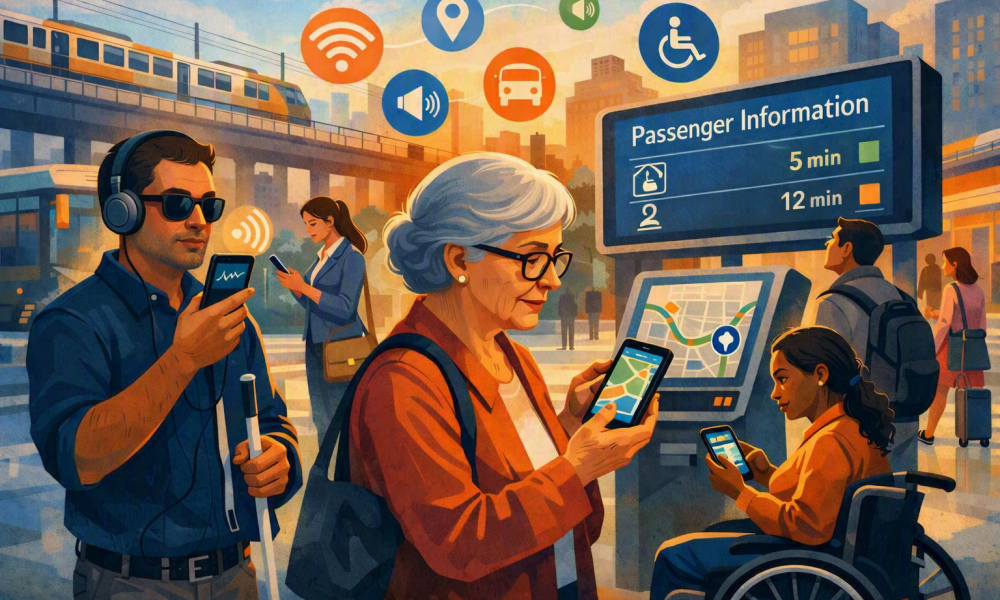
Digital mobility has become the default interface for modern transport. Journey planners, ticketing apps, real time information feeds and multimodal platforms now shape how people move through cities. These tools promise clarity, convenience and personalisation. They promise to make transport easier to understand and easier to use. They promise to remove friction from everyday journeys. Yet millions of people find themselves excluded from these digital systems. They encounter barriers that are subtle, structural and often invisible to designers and operators. The accessibility gap in digital mobility is widening, and it is time for the sector to confront it with honesty and ambition.
Accessibility in transport has always been a complex challenge. Research from the National Centre for Accessible Transport shows that accessibility remains inconsistent and unpredictable across public transport modes, creating significant difficulties for disabled passengers. Digital mobility services were intended to close some of these gaps by offering clearer information, more predictable experiences and more personalised support. Instead, many systems have created new forms of exclusion. Confidence with smartphones is often assumed, along with comfort using complex interfaces. Stable connectivity, strong vision, quick reactions and high digital literacy are treated as universal traits. These expectations do not reflect the realities of millions of travellers.
Digital exclusion is not a fringe issue. Older adults often struggle with small text, low contrast and cluttered layouts. People with cognitive impairments can find complex navigation overwhelming. Visually impaired travellers rely on screen readers that are frequently poorly supported. Limited digital confidence leaves many users worried about making mistakes in apps that offer little guidance. Those who cannot afford the latest devices or reliable data plans face barriers before their journey even begins. Tourists encounter unfamiliar systems and unclear instructions. Anyone navigating transport during stress, disruption or fatigue can quickly become overwhelmed. Digital mobility has become a gatekeeper for participation in public life, and the gate is not open to everyone.
Inclusive design offers a way forward. It is not a technical feature or a compliance checklist but a mindset that places human experience at the centre of digital mobility. This approach acknowledges that people move, perceive and process information in different ways. Accessibility becomes a foundation rather than an optional addition, and digital systems are expected to adapt to human diversity instead of requiring people to adapt to the systems themselves.
Human centred design approaches are increasingly recognised as essential in transport innovation. Recent research highlights the value of prioritising users’ needs, experiences and preferences throughout the creation of products, services and systems. This philosophy moves far beyond designing for a narrow definition of disability and instead embraces the full spectrum of human experience. Digital mobility should feel calm, clear and supportive, with information presented in ways that ease cognitive load. Interfaces need to behave predictably, and alternatives must be available for those who cannot or prefer not to rely on digital tools.
The accessibility gap often begins with information. Many apps present dense screens crowded with icons, menus and options, assuming a level of familiarity with transport terminology that many users simply do not have. Colour coded maps and abstract symbols are treated as universally understood, and interfaces often expect travellers to navigate multiple steps without losing context. For a significant number of people, this is not how real journeys feel. Information becomes a barrier rather than a guide. Inclusive design responds with clarity, simplicity and consistency, favouring plain, human language, intuitive layouts and navigation that feels natural rather than demanding.
The gap also emerges in interaction. Touchscreens require precision. Small buttons require dexterity. Swiping gestures require coordination. Timed screens require speed. Many digital mobility apps do not accommodate tremors, limited mobility or slower reactions. They do not provide alternatives for those who cannot perform certain gestures. They do not offer adjustable controls. Inclusive design requires flexibility. It requires interfaces that adapt to the user rather than expecting the user to adapt to the interface.
The gap becomes even more visible during disruption. When services are delayed, cancelled or rerouted, digital systems often become more complex rather than more supportive. Notifications stack up. Instructions become fragmented. Real time updates become overwhelming. Travellers who are already anxious or stressed find themselves navigating a digital maze at the very moment they need clarity. Inclusive design demands calm communication. It demands information that is prioritised, contextual and reassuring. It demands systems that understand the emotional realities of disrupted travel.
Inclusive design also extends beyond the screen. Digital mobility sits within a wider ecosystem shaped by physical infrastructure, operational behaviour and human support. Journey planners recommending step free routes only succeed when lifts are functioning. Ticketing apps offering accessible options are useful only when station layouts allow those options to be followed. Real time feeds highlighting delays become meaningful when staff are present to assist travellers who need help. True inclusive design relies on coordination across the entire transport system and on digital tools that reflect real world conditions with accuracy and honesty.
Intelligent Transport Systems have a vital role to play. These technologies can detect where accessibility barriers emerge and monitor lift availability, footfall patterns and surface conditions. They also identify points where information becomes unclear and anticipate moments when travellers may need additional support. Operators gain insights that help guide improvements across the network. Research into inclusive ITS in smart cities shows a growing recognition that digital intelligence can underpin more equitable mobility systems. Inclusive design becomes even more effective when paired with real time awareness and predictive capability.
The opportunity for the sector is significant. Inclusive digital mobility is not only a moral imperative but a strategic advantage. Systems that are easier to use draw in more passengers, while those that reduce anxiety help to build trust. Services designed to support diverse needs strengthen resilience across the network, and predictable behaviour within digital tools lowers operational friction. Inclusive design ultimately creates value for everyone, not just for those who face the greatest barriers.
Closing the accessibility gap requires leadership. Designers, operators, policymakers and technologists must recognise that digital mobility is not neutral. It shapes who can participate in society and who can reach work, education, healthcare and community. Confidence in navigating a city is influenced by how these systems behave, determining inclusion for some and exclusion for others. Inclusive design is far from a niche discipline; it stands as a core responsibility for the ITS sector.
Digital mobility can be a powerful enabler of independence, dignity and opportunity. Transport can feel clearer, calmer and more humane when digital tools behave well. Cities benefit too, gaining systems that act with intelligence and empathy. Travellers receive support throughout every stage of their journey. Achieving this requires a genuine commitment to inclusive design, approached with seriousness and creativity. The accessibility gap is real, yet it is not inevitable. With thoughtful design, intelligent systems and human centred thinking, digital mobility has the potential to become a gateway rather than a barrier.
This is the moment for ITS to lead.
Click the buttons below to see more articles:
See all ArticlesIndustry InsightEventsITS Thought LeadershipITS Educational