
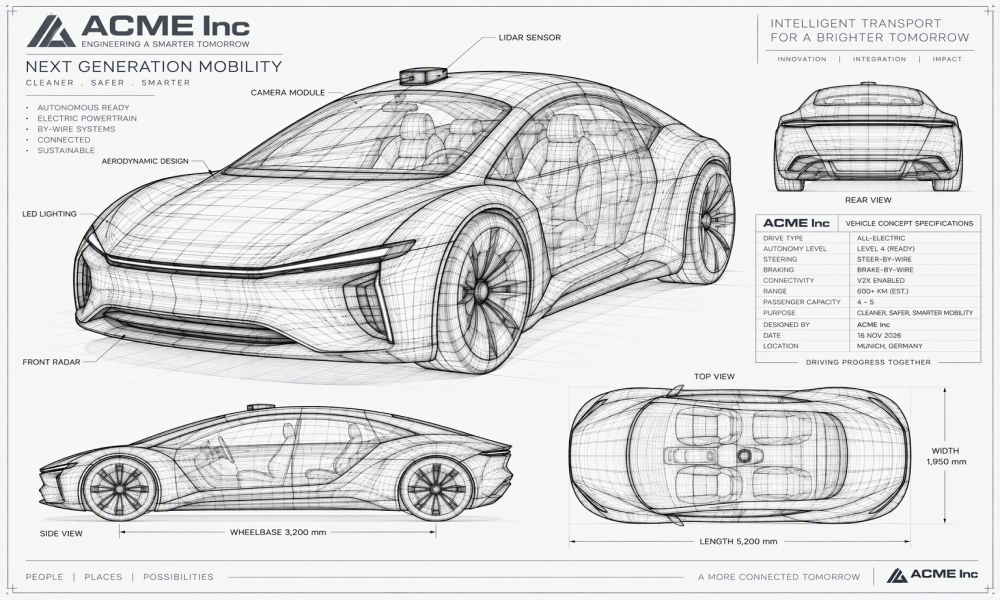
The future of mobility is often discussed through the lens of autonomous driving software, artificial intelligence, connected vehicle ecosystems and electrification. Yet beneath the sophisticated algorithms and digital services that increasingly define modern transport lies a critical layer of engineering that is undergoing a transformation of its own. Steering, braking, suspension and vehicle motion control systems are evolving from largely mechanical components into intelligent, software-driven platforms that will ultimately determine how safely and effectively automated vehicles operate on public roads.
This shift was at the heart of Automotive Chassis Systems Europe 2026, held in Munich on 16-17 November, where industry leaders gathered to explore the future of integrated chassis control, by-wire technologies and vehicle motion management for next generation vehicles. The conference highlighted how economic pressures, accelerating global competition and the growing demands of autonomous mobility are reshaping the development priorities of vehicle manufacturers and technology suppliers alike. Discussions focused heavily on integrated chassis control, vehicle motion control, software-defined vehicles and by-wire technologies that are becoming increasingly central to autonomous vehicle development.
For those involved in Intelligent Transport Systems, the subject matter extends well beyond automotive engineering. The development of smarter chassis architectures has profound implications for road safety, traffic efficiency, connected mobility services and the future operation of automated transport networks. One of the most significant themes emerging from the event was the convergence of traditionally separate vehicle systems into integrated control platforms. Historically, steering, braking and suspension functions were developed and managed independently. In contrast, modern autonomous vehicles require continuous coordination across all these systems to ensure safe and predictable operation in complex real-world environments.
Integrated chassis control provides precisely that capability. By combining data from sensors, cameras, radar, lidar and vehicle dynamics systems, central control platforms can continuously optimise vehicle behaviour. Such integration enables vehicles to respond more effectively to changing road conditions, sudden hazards and varying traffic demands. For ITS practitioners, this represents an important bridge between vehicle intelligence and network intelligence. Vehicles increasingly become dynamic participants within a connected transport ecosystem, capable of reacting not only to immediate conditions but also to information received from infrastructure and other road users.
The rise of by-wire technologies featured prominently throughout the conference. Steer-by-wire and brake-by-wire systems eliminate conventional mechanical connections, replacing them with electronic signals and software-based control. While the concept has existed for many years, the technology is now reaching a level of maturity that supports large-scale deployment in automated and software-defined vehicles. Conference organisers noted that rapidly advancing by-wire technologies are becoming key differentiators within the global automotive sector. From an ITS perspective, by-wire architectures open up entirely new opportunities. Electronic control systems can be updated remotely, calibrated dynamically and integrated more easily with higher-level automated driving functions. As vehicles become increasingly connected, the ability to modify performance characteristics through software updates provides flexibility that traditional mechanical systems simply cannot offer.
Road safety stands to benefit significantly from these developments. Human drivers are often limited by reaction times, situational awareness and varying levels of skill. Integrated chassis systems can react in milliseconds to maintain vehicle stability, optimise braking performance and avoid loss of control. In autonomous operation, these capabilities become even more important. Safe automated driving depends not only on perception and decision-making systems but also on the vehicle's ability to execute commands accurately and reliably. This creates an important challenge for the ITS community. Future road safety strategies will need to account for vehicles whose performance characteristics can evolve through software. Regulatory frameworks, testing methodologies and certification processes must adapt accordingly. Ensuring public confidence in automated transport will depend as much on the reliability of vehicle control systems as on the competence of artificial intelligence decision engines.
A recurring discussion point throughout the event was the growing influence of software-defined vehicle architectures. Sessions explored how chassis systems are increasingly being developed as software platforms capable of receiving updates, adding functionality and integrating new services throughout a vehicle's lifecycle.
The implications for transport networks are substantial. Vehicles operating within connected corridors may eventually adapt their behaviour based on infrastructure guidance, real-time traffic conditions or broader network optimisation objectives. Dynamic speed management, cooperative manoeuvring and platooning applications become more achievable when vehicle control systems can respond precisely to digital instructions.
Such capabilities align closely with many of the ambitions already driving ITS investment across Europe. Connected and Cooperative ITS programmes have long sought to create stronger links between vehicles and infrastructure. Advanced chassis control technologies may finally provide the physical platform capable of fully realising those ambitions.
The conference also highlighted the competitive pressures facing European manufacturers. Organisers noted the rapid progress being made by Chinese vehicle manufacturers and suppliers, particularly in areas such as active suspension, electromechanical actuation and by-wire technologies. Fast development cycles, highly automated production facilities and integrated engineering approaches are enabling new entrants to challenge traditional automotive leaders.
This competitive landscape has relevance far beyond the automotive sector. Transport authorities and mobility planners increasingly depend on vehicle technologies to support broader policy objectives around safety, sustainability and network efficiency. The pace at which innovation reaches the market will influence how quickly cities and regions can deploy advanced mobility services and realise the benefits promised by intelligent transport strategies.
Perhaps the most important takeaway from Automotive Chassis Systems Europe 2026 was the growing recognition that autonomous mobility depends upon a tightly integrated technology stack. Artificial intelligence may capture headlines, but without advanced chassis systems capable of executing decisions safely and reliably, truly autonomous transport cannot exist.
For ITS professionals, the message is clear. Future mobility will be shaped as much by developments in steering, braking and vehicle dynamics as by advances in connectivity, data analytics and automation software. The integration of chassis control, by-wire architectures and software-defined vehicle platforms represents a crucial enabling layer that will underpin the next generation of connected and autonomous transport systems.
As the industry moves towards higher levels of automation, the distinction between vehicle engineering and transport systems engineering continues to blur. Roads, infrastructure and vehicles are becoming increasingly interconnected components within a single intelligent ecosystem. Events such as Automotive Chassis Systems Europe provide a valuable reminder that the path to autonomous mobility is not being built solely in the digital domain. It is also being engineered through the intelligent control systems that ensure every automated decision can be translated into safe, smooth and reliable movement on real roads.
Click the buttons below to see more articles:
See all ArticlesIndustry InsightEventsITS Thought LeadershipITS Educational