150x150.png)
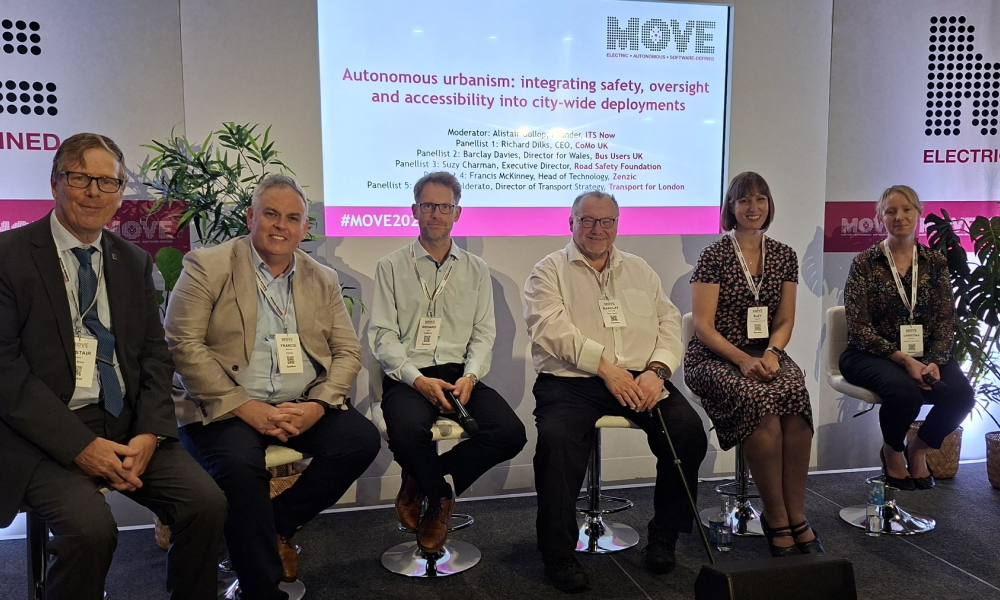
The Autonomous Vehicles Stage at MOVE 2026 was the venue for an illuminating discussion to explore how safety, oversight and accessibility are integrated into automated mobility deployments. London has a way of sharpening the edges of any conversation about the future of mobility, with the density, complexity, politics and the sheer lived reality of moving millions of people every day. It was the perfect backdrop for a session that refused to treat autonomy as a technology story. This was a conversation about cities, people, governance and the uncomfortable truth that autonomy will only deliver public value if we design for it, deliberately, collectively and with a clear-eyed sense of what’s at stake.
I opened the session with a simple provocation: If autonomous urbanism is finally moving from pilots to real deployments, what is the single biggest barrier standing between us and genuine public value? The answers, as it turned out, were anything but simple.
Richard Dilks, CEO of CoMoUK, set the tone immediately. His organisation’s recent piece of work on automated vehicles has already raised a red flag, AVs could strengthen shared mobility — or they could quietly undermine it.
Richard’s warning was crisp, “If we sleepwalk into autonomy as another private, single-occupancy mode, we will worsen congestion, weaken public transport, and miss our climate goals”. This wasn’t the usual AV optimism, it was a reminder that the future is not guaranteed to be better.
He painted a picture of a city where AVs plug into mobility hubs alongside shared bikes, car clubs, e-scooters and demand-responsive services, a networked ecosystem rather than a new silo. But that vision depends on something cities often struggle with, spatial discipline. Kerbside management, charging layouts, pick-up and drop-off design, and the integration of accessibility features from day one. “If we get the spatial layer wrong,” he said, “we get the inclusion layer wrong too”.
Where Richard spoke to the urban fabric, Barclay Davies of Bus Users UK brought the conversation firmly into the lived experience of passengers, especially those outside major cities.
For Barclay, autonomous buses are not a novelty. They are a potential lifeline. “There are communities in Wales where traditional bus services are no longer viable,” he said. “Autonomous operation could keep those places connected, but only if the conditions are right”.
Funding, regulation, and public trust formed his triad of essentials. But it was his focus on co-production that landed hardest. “Passengers don’t just need to be safe. They need to feel safe. Disabled users need to know someone is accountable, someone is listening, someone is designing with them, not for them”. In an automated future, trust will need to be earned, so the early involvement of users is essential to give them a feeling of ownership in the services they rely on.
If anyone was going to challenge the room’s assumptions about safety, it was Suzy Charman, Executive Director of the Road Safety Foundation. She didn’t disappoint.
“Safe enough,” she said, “is not a vibe, it needs to be evidence based.” Her Safe System framing cut through the noise, with measurable risk reduction, transparent data and a clear governance structure for deciding when an AV system is ready for public roads.
But Suzy’s most pointed intervention was about infrastructure. “We talk endlessly about sensors and AI, but cities are still underestimating the basics, speed management, road design, infrastructure quality. If we don’t fix the fundamentals, autonomy will inherit our weaknesses, not solve them”.
It was a reminder that AVs are not magic. They are systems operating within systems and those systems need to be safe before autonomy ever arrives.
Francis McKinney of Zenzic widened the lens again. His world is interoperability, standards and digital infrastructure, the invisible architecture that determines whether autonomy scales or stalls.
He warned of a familiar pattern where vendor push can overwhelm city pull. “If deployments are driven by what suppliers can offer rather than what cities actually need, we end up with fragmentation, duplication and stranded assets”. His solution? Standards, shared data frameworks and procurement models that reward alignment with city outcomes rather than proprietary advantage.
Then came the energy paradox. As cities build digital twins, V2X corridors and edge compute, the energy demand of the digital layer rises sharply. “We cannot pretend that autonomy is carbon-neutral just because the vehicles are electric”, he said. “The digital infrastructure has a footprint, and we need to plan for it”.
Finally, Christina Calderato of Transport for London grounded the conversation in the realities of a megacity. TfL’s strategy has always been multimodal, integrated and relentlessly focused on public value. Autonomy, she argued, must fit into that logic, and not disrupt it.
“London doesn’t need more modes”, she said. “It needs better integration”. So, it is vitally important that emerging autonomous services complement buses, rail and active travel, not cannibalise them. To this end, governance will be the vital factor. Real-time oversight, data transparency and clear accountability structures will determine whether autonomy becomes a trusted layer of the transport system or a contested one.
Her message was unmistakable, autonomy must serve the city, not the other way around.
To close, I threw a question across the panel that had been simmering beneath the surface: Is autonomy a public service or a commercial service?
The answer was clear, autonomy will only succeed if it behaves like a public service, even when delivered by commercial operators. That means reliability, accessibility, transparency, and alignment with city goals. It means designing for people, not just for technology.
What emerged from the session was not a single narrative but a shared understanding that autonomous urbanism is not inevitable, and it is not inherently good. It will only deliver public value if cities, operators, regulators and communities design it that way, together.
Safety must be measurable. Inclusion must be intentional. Governance must be long-term. Infrastructure must be ready. Autonomy must strengthen, not fragment, the transport networks people rely on every day.
MOVE 2026 made it clear, that the future of autonomous mobility will not be written by technology alone. It will be written by the choices cities make now.
The Autonomous Urbanism panel was part of the MOVE Conference 2026
Moderator: Alistair Gollop, Founder, ITS Now
The panellists were:
Click the buttons below to see more articles:
See all ArticlesIndustry InsightEventsITS Thought LeadershipITS Educational