
For much of the past decade, transport policy has been increasingly framed through the lens of carbon reduction. Climate targets, net zero strategies and emissions reporting have become central considerations for governments, transport authorities and infrastructure operators around the world. Few would dispute the importance of reducing transport's environmental impact. Road transport remains one of the largest contributors to greenhouse gas emissions in many developed economies, creating a clear imperative for action.
Yet a growing debate is emerging across the mobility sector. While carbon reduction remains a critical objective, should it always be the dominant measure of success? Increasingly, transport professionals are questioning whether an exclusive focus on carbon can sometimes obscure the wider purpose of transport itself. After all, mobility is not an end in itself. Transport exists to connect people with jobs, education, healthcare, leisure and each other. A transport system that reduces emissions but restricts accessibility, reliability or economic opportunity may ultimately fail the communities it is intended to serve.
This tension between carbon outcomes and mobility outcomes is becoming one of the defining challenges for Intelligent Transport Systems (ITS) and mobility technology. The question is no longer whether transport should become more sustainable. Rather, it is how sustainability can be achieved without undermining the movement of people and goods that modern societies depend upon.
The challenge is particularly relevant for the ITS sector because intelligent transport technologies often sit at the intersection of environmental, social and economic objectives. Unlike infrastructure projects that may take decades to deliver, digital transport interventions can produce measurable benefits relatively quickly. However, determining which benefits should be prioritised is becoming increasingly complex.
Consider congestion management as an example. Traditional environmental thinking might assume that reduced vehicle use is inherently beneficial because it lowers emissions. From a mobility perspective, however, the situation is more nuanced. Congestion itself generates significant emissions through stop-start traffic, extended journey times and inefficient vehicle operation. Intelligent traffic signal control systems, adaptive junction management and connected vehicle technologies can therefore produce carbon reductions not by discouraging movement, but by enabling movement to occur more efficiently.
This distinction is important because it challenges the often-simplistic assumption that fewer vehicle miles automatically represent a better transport outcome. In many cases, smarter mobility can deliver both environmental and societal benefits simultaneously. A freight vehicle that reaches its destination more efficiently produces fewer emissions per delivery. A bus that receives traffic signal priority becomes more attractive to passengers while consuming less fuel during its journey. A traveller who receives accurate real-time information may avoid unnecessary delays and make more efficient modal choices.
Such examples demonstrate the unique value proposition of ITS. Rather than forcing a choice between mobility and sustainability, intelligent technologies frequently allow both objectives to be pursued at the same time. Problems arise when policy frameworks measure success using only one dimension of performance. A transport authority might celebrate a reduction in traffic volumes while overlooking deteriorating accessibility for suburban communities. Equally, a city could pursue ambitious decarbonisation measures that inadvertently increase travel inequality by making mobility more difficult for certain groups.
The emergence of mobility-as-a-service platforms has further highlighted this challenge. Digital integration of transport modes was once expected to reduce private car dependency dramatically. Although progress has been made in many urban environments, experience has shown that behavioural change is often more complicated than anticipated. Travellers tend to prioritise convenience, reliability, affordability and journey time over abstract environmental considerations. This reality has important implications for technology providers. Solutions designed primarily around carbon objectives may struggle to achieve widespread adoption if mobility outcomes are compromised. Conversely, technologies that enhance user experience often generate environmental benefits as a consequence of improved efficiency rather than through direct restriction.
The debate becomes even more pronounced when considering rural and semi-rural transport networks. Urban centres frequently have access to alternative transport modes, dense public transport services and active travel infrastructure. Rural communities face very different circumstances. In many locations, private vehicles remain essential for employment, healthcare access and social inclusion. A carbon-first approach that focuses exclusively on reducing road traffic may therefore produce markedly different outcomes depending on geography. Intelligent transport technologies can help address this challenge through demand-responsive transport, connected mobility platforms and advanced journey planning systems. These solutions recognise that sustainable mobility may require different approaches in different contexts rather than relying on universal assumptions about travel behaviour.
Freight and logistics provide another compelling illustration of the carbon-versus-mobility dilemma. Modern economies depend upon highly efficient goods movement networks. Efforts to reduce emissions must therefore be balanced against maintaining supply chain resilience and economic competitiveness. Here, intelligent transport systems are increasingly proving their value. Connected freight corridors, predictive traffic management, digital logistics platforms and vehicle routing optimisation can significantly reduce emissions without reducing freight activity itself. The focus shifts from limiting movement to improving the efficiency of movement. Such an approach acknowledges that economic prosperity and environmental sustainability do not necessarily have to exist in opposition.
The rapid development of vehicle electrification introduces further complexity. Electric vehicles are often presented as a solution that reconciles mobility and carbon objectives. In many respects they do exactly that, allowing continued personal mobility while reducing tailpipe emissions. Nevertheless, transport professionals increasingly recognise that electrification alone cannot resolve broader concerns relating to congestion, network performance, road safety and urban space allocation. This is where the ITS sector has an opportunity to demonstrate leadership. Smart charging management, vehicle-to-infrastructure communications, connected traffic systems and predictive network operations can maximise the benefits of electrification while addressing wider transport challenges. The objective becomes creating a transport ecosystem that is simultaneously cleaner, safer and more efficient.
Data is likely to become the decisive factor in resolving the carbon versus mobility debate. Historically, transport performance metrics have often operated within organisational silos. Environmental teams focused on emissions. Traffic managers concentrated on journey times. Road safety specialists monitored collisions. Public transport operators measured patronage. The next generation of intelligent transport systems offers the possibility of integrating these perspectives. Digital twins, advanced analytics and AI-powered network management can evaluate multiple outcomes simultaneously. Rather than judging interventions solely by carbon reduction or traffic flow improvements, authorities can assess their impacts across a range of environmental, economic and social indicators.
Such an approach reflects the reality that transport networks serve multiple purposes. A successful transport system is not merely one that minimises emissions. Nor is it one that simply maximises movement. Success lies in enabling people and goods to move safely, efficiently and equitably while minimising environmental harm.
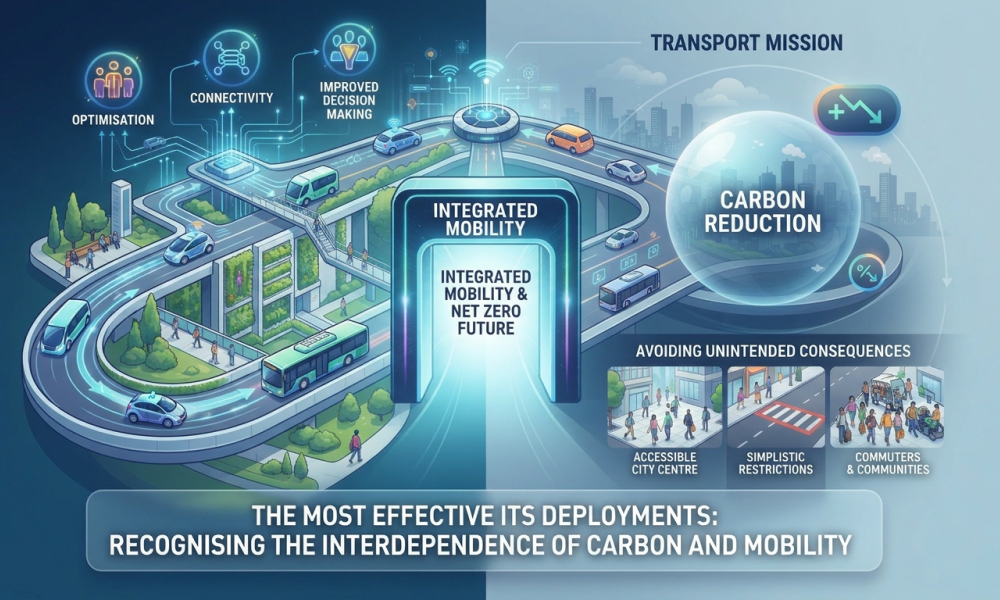
Looking ahead, the most effective ITS deployments are unlikely to be those that treat carbon and mobility as competing objectives. The real opportunity lies in recognising their interdependence. Intelligent transport technologies are uniquely positioned to reduce emissions through optimisation, connectivity and improved decision making rather than through restrictions alone. As policymakers continue to navigate the transition towards net zero, there is a risk that simplistic measures of success could create unintended consequences. Transport professionals should therefore remain focused on the fundamental purpose of mobility. Carbon reduction matters enormously, but it should be viewed as one component of a broader transport mission rather than the sole destination.
The future of intelligent transport will ultimately be defined not by how effectively it limits movement, but by how intelligently it enables sustainable movement. In that balance between environmental responsibility and human mobility lies perhaps the greatest opportunity for the ITS sector in the decades ahead.
Click the buttons below to see more articles:
See all ArticlesIndustry InsightEventsITS Thought LeadershipITS Educational