150x150.png)
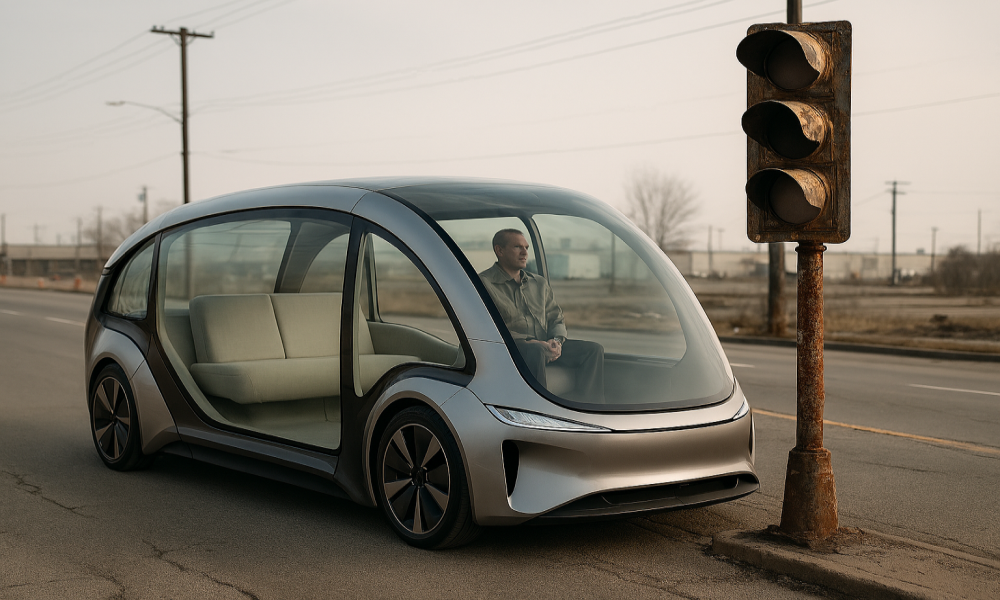
For much of the past decade, Intelligent Transport Systems have been tasked with keeping pace with incremental change: more connected vehicles, more sensors at the roadside, more data flowing into traffic management centres. But the next phase of automotive innovation suggests that “keeping pace” will no longer be enough. As vehicles become predictive, autonomous and deeply intelligent, ITS infrastructure itself will need to evolve, not simply to manage traffic, but to collaborate with vehicles as part of a shared, adaptive mobility ecosystem.
The implications are significant. Roadside systems will increasingly be expected to communicate intent, not just information. Traffic signals, energy networks and digital twins of urban networks will need to operate at machine speed, exchanging data with vehicles that can anticipate conditions rather than merely respond to them. In this context, the future of ITS is inseparable from the future of the vehicle.
This convergence was a central theme at the International Conference on Automotive Technology and Mechanical Engineering Solutions (ICATMES) 2026, held virtually on 1 April. While the event focused primarily on vehicle engineering, the message for ITS professionals was clear: the way cars are being designed today will fundamentally redefine what transport infrastructure must deliver tomorrow.
For several years, the automotive industry has championed the concept of the software-defined vehicle. Over-the-air updates, modular electronic architectures and cloud-based services promised continuous improvement long after a vehicle left the factory. At ICATMES 2026, however, speakers suggested that this model has already reached its limits.
The emerging paradigm is the AI-native vehicle, one designed from the ground up around artificial intelligence rather than software layered onto mechanical systems. Researchers described architectures in which decentralised AI agents actively manage steering response, braking behaviour and suspension dynamics in real time.
This shift is powered by what engineers termed predictive physics control. Using edge computing and constant sensor fusion, vehicles can forecast changes in road conditions, surface friction or aerodynamic load milliseconds before they occur. Instead of reacting to a hazard, the vehicle anticipates it.
For ITS, this marks a turning point. Infrastructure can no longer assume vehicles will simply obey signals or warnings. Instead, systems must provide high-confidence, machine-readable information with the reliability and latency required for vehicles that make decisions at speed.
Nowhere is this more evident than in the evolution of Vehicle-to-Everything (V2X) communication. While V2X has long promised safer intersections and smoother traffic flow, ICATMES 2026 revealed how deeply embedded these protocols are becoming within vehicle control strategies.
At Level 4 autonomy, the focus is shifting from “seeing” the road to communicating with it. Vehicles are increasingly designed to exchange data not just with one another, but with traffic signals, smart energy grids and urban control platforms. The goal is to optimise movement across entire networks, reducing congestion, smoothing energy demand and minimising unnecessary acceleration and braking.
For ITS operators, this implies a step change in responsibility. Infrastructure is no longer passive. It becomes a real-time data partner, expected to provide consistent, standardised inputs that vehicles can trust and act upon without human intervention.
Electrification was another major theme at ICATMES, particularly the mechanical challenges of integrating solid-state batteries into vehicle platforms. While much attention has focused on chemistry, researchers highlighted how battery design is becoming inseparable from vehicle structure itself.
A new honeycomb thermal matrix concept showcased at the conference uses phase-change materials and micro-lattice structures to manage heat passively, reducing both weight and complexity. Battery packs could be up to 15 per cent lighter, while interlocking mechanical housings improve crash resilience.
For ITS, the relevance is subtle but important. Lighter vehicles with improved thermal efficiency alter energy consumption patterns across networks. When combined with V2X connectivity, this enables vehicles to coordinate charging behaviour with smart grids — shifting demand away from peak periods and reducing strain on urban energy infrastructure.
ICATMES 2026 also underscored a growing recognition that sustainable mobility extends well beyond emissions. Sessions on hydrogen-reduced steel and recycled carbon fibre composites highlighted how material choices are reshaping vehicle lifecycles.
Particularly striking were results from crash tests involving bio-composite frames. Hemp-based fibre reinforcements, paired with recycled aluminium, demonstrated tensile strength comparable to traditional steel while being around 30 per cent lighter.
For ITS planners and city authorities, these developments feed directly into long-term asset planning. Lighter vehicles reduce road wear, change maintenance cycles and influence how infrastructure investment is prioritised. Sustainability, once a vehicle-centric metric, becomes a system-wide concern.
One of the conference’s most consequential announcements was the unveiling of a unified cloud-based simulation protocol for digital twins. This allows multiple suppliers of motors, braking systems, software platforms to test components together in a shared virtual environment before physical manufacturing begins.
Development cycles can be cut dramatically, from years to months, while stochastic analysis enables engineers to predict component wear across hundreds of thousands of kilometres with remarkable accuracy.
The parallel for ITS is unmistakable. As vehicles move towards virtual-first development, transport authorities are increasingly expected to maintain digital twins of road networks that mirror real-world conditions. The future lies in co-simulation, vehicles and infrastructure tested together in shared digital environments long before deployment on public roads.
Despite the rise of autonomy, ICATMES 2026 closed with a reminder that humans remain central to the mobility system. Advances in haptic augmented reality interfaces — allowing drivers to “feel” controls in mid-air using ultrasonic waves — aim to reduce distraction while maintaining intuitive interaction.
For ITS, this reinforces the importance of human-centred design. Even as systems become more automated, trust, clarity and usability remain critical. The most intelligent infrastructure in the world will fail if users do not understand or trust how it works.
ICATMES 2026 made one thing abundantly clear: the automotive industry is no longer developing in isolation. Vehicles are becoming predictive, communicative and structurally intertwined with the systems around them. For Intelligent Transport Systems, this represents both a challenge and an opportunity.
The next generation of ITS will not simply manage traffic. It will coordinate energy, exchange intent with AI-driven vehicles and operate as an equal participant in an increasingly intelligent mobility ecosystem.
As these technologies move from virtual conference halls to real streets, the direction of travel is unmistakable. Smarter vehicles demand smarter infrastructure and the future of mobility will be built where the two meet.
Click the buttons below to see more articles:
See all ArticlesIndustry InsightEventsITS Thought LeadershipITS Educational