
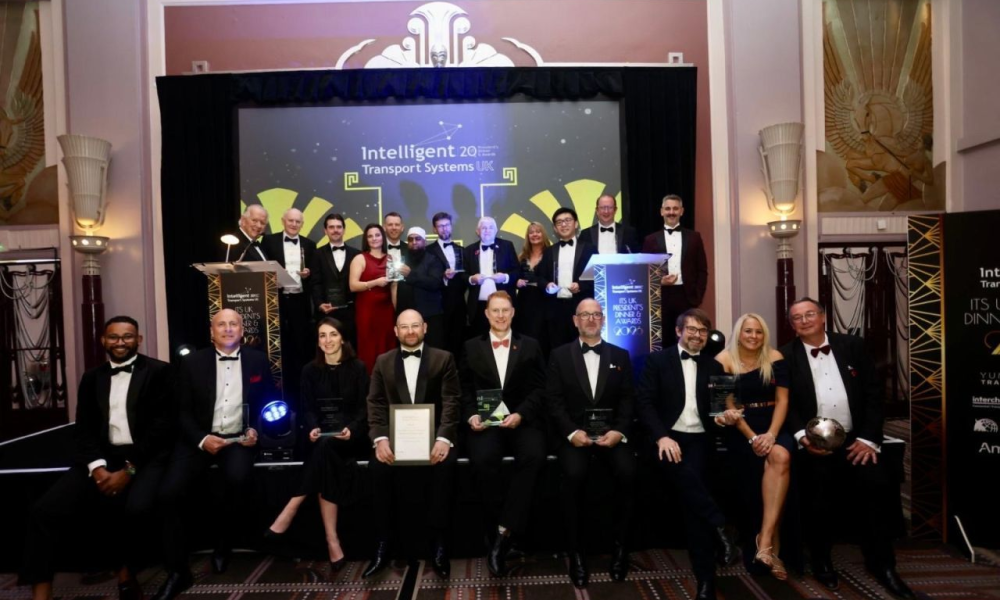
There are some evenings that serve as a reminder of just how much can be achieved when innovation, collaboration and determination come together. The 20th Intelligent Transport Systems UK President’s Dinner and Awards, held at the Sheraton Grand Park Lane in London on 10 November, was one of those occasions. Bringing together 350 members, partners, policymakers and industry leaders, the event celebrated not only the remarkable achievements of the past year but also the people and organisations helping to define the future of transport across the United Kingdom.
Marking two decades of the President’s Dinner, this year’s event carried a special significance. Against a backdrop of rapid technological change, evolving mobility needs and growing expectations around sustainability, accessibility and safety, the awards offered a timely opportunity to recognise those who are transforming ambition into real-world results. From pioneering digital twins and connected vehicle services to accessibility innovations and carbon reduction tools, the winners demonstrated the breadth and maturity of a sector that continues to move from innovation towards large-scale deployment.
Proceedings began with addresses from ITS UK Chief Executive Max Sugarman, ITS UK President Steve Norris and Minister for Roads Justin Madders MP, whose presence underlined the growing importance of intelligent transport technologies within the UK's transport strategy. Throughout the evening there was a clear sense of confidence in the sector's direction of travel, accompanied by recognition that the challenges facing transport require ever greater partnership between government, industry, academia and technology providers.
One of the most prestigious individual honours of the evening, the Rees Hills Award for Outstanding Personal Contribution, was presented to Chris Lane. Named after transport technology pioneers Neville Rees and Peter Hills, the award recognises professionals whose careers have left a lasting imprint on the sector. The judges highlighted Chris Lane’s extraordinary contribution across almost four decades, including his leadership of the highly successful Swift smartcard programme in the West Midlands, his role in establishing the region as a testbed for connected and automated mobility, and his involvement in securing the 2027 ITS World Congress for Birmingham. Taken together, those achievements represent a career dedicated to advancing innovation while delivering practical benefits for transport users.
International recognition was also celebrated through the Richard Harris Award for International Achievement, presented to Ian Patey of WSP. For more than 40 years, Patey has been a familiar and influential figure within the global ITS community, helping to connect UK expertise with international best practice. His contribution has ranged from supporting pioneering schemes such as the M42 Active Traffic Management pilot through to leading WSP's Global ITS Network and shaping worldwide guidance through PIARC. The award reflected not only personal achievement but also the increasingly international nature of intelligent transport systems.
The next generation of industry leaders was represented by Oscar Law of Transport for Greater Manchester, recipient of the Eric Sampson Award for Early Careers Professional of the Year. Having joined TfGM as a graduate engineer only three years ago, Law has already established a reputation for technical excellence and leadership, supporting critical network operations while mentoring apprentices and helping develop technical capability within the organisation. His recognition demonstrated the depth of emerging talent entering the sector.
Another inspiring individual success came through the Jennie Martin Award for ITS Woman of the Year, awarded to Andrea Reacroft of Tees Valley Combined Authority. Under her leadership, Tees Valley has become one of the UK's most innovative regions for digital transport, delivering the country's first region-wide automated traffic digital twin and supporting the introduction of autonomous vehicle operations at Teesside International Airport. The judges described her as both technically accomplished and generous with her expertise, making her an influential role model for women working across intelligent transport.
While individual achievements featured prominently throughout the evening, the awards also highlighted projects demonstrating exceptional real-world impact. Nowhere was this more evident than in the Project of the Year Award, which went to Tees Valley Combined Authority and Aimsun for Digital Twin-Bus Reliability: The UK's First Regionwide Automated Traffic Digital Twin. Selected from among all category winners, the project impressed judges through its combination of technological innovation, operational deployment and measurable benefits. Covering more than 1,700 miles of urban and rural road network across five local authorities, the digital twin is helping transform how traffic management interventions are identified and implemented in real time.
The same project also secured the Public Transport Award, reinforcing the growing role of digital twins in improving public transport performance and reliability. Such recognition reflects a wider shift within the ITS sector towards integrated, data-driven operational management capable of delivering tangible improvements for passengers.
Accessibility remained another major theme of the evening. The Better Accessibility through Technology Award was shared between QRoutes and Inclutech.co, recognising two very different but equally impactful approaches to inclusion. QRoutes was honoured for its work with Hertfordshire County Council, where intelligent planning tools are helping optimise transport provision for SEND pupils while significantly reducing costs. Meanwhile, Inclutech.co's TapSOS platform was recognised for making emergency services more accessible to people who may struggle with traditional voice calls, demonstrating how digital innovation can break down long-standing barriers.
Safety continued to feature strongly across the awards programme. The Better Safety through Technology Award went to FORS for its Safe Urban Driving course, which now incorporates virtual reality technology to help drivers understand hazards from the perspective of cyclists and pedestrians. Meanwhile, South-East Coast Ambulance Service NHS Foundation Trust and HAAS Alert received the Client or Public Sector Body of the Year Award for deploying digital warning systems across the ambulance fleet, resulting in hundreds of thousands of driver alerts and a measurable reduction in collisions.
Environmental sustainability also featured prominently. Telent Technology Services claimed the Greater Sustainability through Technology Award for its Design Carbon Appraisal Tool, enabling carbon impacts to be considered before procurement decisions are made. By embedding carbon intelligence into project design and planning, the solution illustrates how digital tools can support progress towards Net Zero objectives while improving decision making.
Elsewhere, Amey, together with National Highways, Transport for Greater Manchester and SYSTRA, secured the Changing Behaviour with Technology Award for a project designed to influence travel choices around major events in Greater Manchester. By combining behavioural insight, data and journey planning, the initiative highlighted the sector's increasing emphasis on managing mobility rather than simply managing traffic.
The Digitalisation & Digital Services Award recognised Immense for its innovative work on the A382 Dynamic Diversion Routes project in Devon, showcasing the power of advanced digital modelling throughout the planning and delivery lifecycle. WSP's Connected Vehicle Services Strategic Implementation Programme picked up the Connected & Automated Mobility Award, demonstrating how policy ambitions for connected transport are steadily being translated into practical deployment frameworks.
Commercial success was recognised through Yunex Traffic's Exporter of the Year Award and Littlepay's Start-Up or Scale-Up of the Year Award, highlighting the strength of UK innovation both at home and abroad. Together they demonstrated the global reach and entrepreneurial spirit that continues to characterise the country's transport technology sector.
Perhaps the most symbolic moment of the evening came with the ceremonial handover of the ITS World Congress globe. Presented by ERTICO CEO Joost Vantomme to Roads Minister Justin Madders MP, the globe signalled the countdown to the 2027 ITS World Congress in Birmingham. With an anticipated 15,000 delegates expected to attend, the event will provide an unprecedented opportunity to showcase British innovation on the global stage.
As guests departed following a memorable evening of celebration, recognition and optimism, one message stood out above all others. Intelligent transport systems are no longer future concepts or isolated pilots. Across the UK they are delivering measurable improvements in safety, accessibility, sustainability and operational performance. The winners of the 2026 ITS UK President’s Awards represent the very best of that progress, providing powerful evidence that technology, when combined with vision and collaboration, can help create a cleaner, safer and more efficient transport system for everyone.
Click the buttons below to see more articles:
See all ArticlesIndustry InsightEventsITS Thought LeadershipITS Educational