
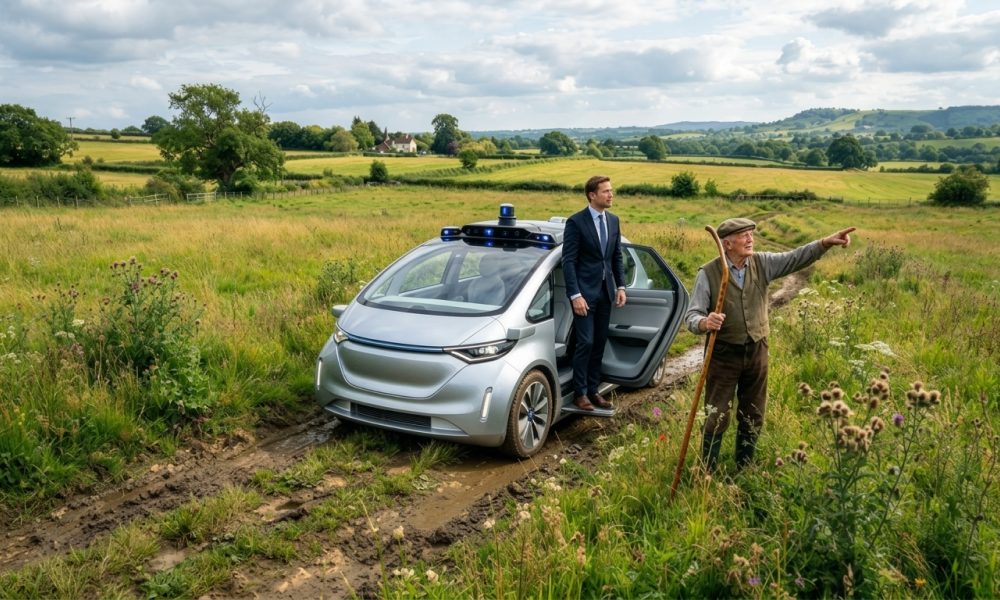
For more than a decade, connected and autonomous vehicles have occupied an unusual place in the transport conversation. They have been simultaneously ever-present and perpetually just over the horizon. Demonstrations have multiplied, research programmes have flourished and promotional videos have painted compelling visions of driverless journeys. Yet for all the excitement, everyday deployment at scale has remained elusive.
At Highways UK 2026, I chaired a panel bringing together experts from Transport for London, National Highways, TRL, Connected Places Catapult and strategic advisers to explore a question that is becoming increasingly difficult to avoid. As regulation begins to mature and commercial operators prepare to launch services on public roads, is the UK genuinely ready to move from controlled pilots to real-world autonomous mobility?
One theme emerged almost immediately. The challenge is no longer primarily about vehicle technology. Increasingly, it is about everything around it. Michael Dnes of Stonehaven began by challenging one of the most common assumptions in the autonomous vehicle debate. Contrary to perceptions, autonomy itself is not particularly new. London's Victoria Line has been operating with automated systems since the late 1960s. The difference today is that automation is no longer confined to highly controlled environments.
Historically, autonomy succeeded because infrastructure could be tightly managed. Rail networks are predictable, segregated and carefully governed. Public roads are none of those things. They are dynamic, messy and full of variables. The answer, according to Dnes, is not vast investment in dedicated autonomous vehicle infrastructure. Industry has little appetite for segregated networks or special lanes. Commercial operators want to work within existing road systems because that is where the market exists.
Instead, attention is increasingly turning towards what he described as "invisible infrastructure" which encompasses data, regulation, digital records and information flows that allow machines to understand and interpret the road environment.
Roadworks information, traffic regulations, digital traffic orders and machine-readable network data may not attract the same attention as advanced sensors or roadside communications systems, but they could ultimately prove more important. In this respect, the UK may already possess an advantage. Initiatives such as Digital Traffic Regulation Orders and standards-based approaches to traffic signal data are gradually creating a transport ecosystem that is becoming more understandable to automated systems.
It is not about building a new road network. It is about making the existing one visible to machines. That distinction also changes the conversation around commercial readiness. According to Dnes, the UK's deployment challenge differs significantly between London and the rest of the country. The capital already possesses a strong commercial attraction. Global mobility companies are eager to operate there because the potential market is large and concentrated. The question for London centres on trust between operators and public authorities, creating sufficient confidence for regulatory approvals and deployment frameworks.
Elsewhere, the challenge is different. Cities such as Birmingham, Manchester, Glasgow and Edinburgh must establish compelling business cases that justify investment and attract commercial operators. Technology readiness alone will not secure deployment. Market viability matters just as much. For London, however, commercial opportunity cannot be separated from wider transport policy objectives.
Alina Tuerk of Transport for London outlined the delicate balancing act facing the capital. London is pursuing ambitious goals around sustainable travel, accessibility and Vision Zero road safety targets. Automated mobility could potentially support many of those ambitions, particularly regarding accessibility and safety.
At the same time, concerns remain about unintended consequences. Automated taxi and private hire services could increase vehicle mileage and place additional pressure on already congested streets. Kerbside space is already one of London's most fiercely contested assets, with buses, cabs, freight operators, cyclists, pedestrians and servicing activities competing for limited capacity. Autonomous vehicles now represent another claimant on that valuable roadspace.
Governance therefore becomes critical. Tuerk highlighted an interesting dynamic within the UK's emerging framework. While automated passenger service permits will be issued by central government through the Driver and Vehicle Standards Agency (DVSA), Transport for London must provide consent before services can operate in the capital.
To help manage expectations and build public confidence, TfL is developing guidance for prospective operators covering everything from strategic objectives to practical operational requirements, including incident management and coordination with emergency services.
Public trust may prove one of the most important factors determining deployment success. High-profile examples from international markets, including autonomous vehicles stopping unexpectedly or responding poorly to unusual situations, have demonstrated how quickly confidence can be undermined.
The deployment pathway may therefore depend as much on governance and accountability as it does on artificial intelligence. Preparation is equally important from an infrastructure perspective, although not necessarily in the ways many authorities assume. Marcel Pooke of Connected Places Catapult argued that one of the biggest risks lies in becoming trapped in an endless cycle of pilots. Testing technology is relatively straightforward. Scaling it into operational services is far harder.
Too often, lessons learned from trials remain within individual organisations. Other authorities subsequently commission similar projects, repeating the same exercises rather than building collectively on previous experience. The result is slower progress and unnecessary duplication. Perhaps more importantly, authorities should resist the temptation to pursue technology simply because it appears innovative.
The starting point should be understanding existing assets. Most organisations already possess substantial data resources, asset registers, GIS systems and operational information. Before investing in digital twins, roadside equipment or new connected technologies, authorities should understand what capabilities already exist and identify the operational problems they are actually trying to solve. The question is not whether to buy a digital twin, but to understand what decisions need improving and which tools are genuinely required to achieve that outcome.
John Mathewson of National Highways demonstrated how that thinking has evolved within strategic road management. Early connected vehicle programmes focused heavily on direct roadside communications and short-range technologies. Increasingly, the emphasis has shifted towards data sharing.
Rather than communicating directly with every vehicle, National Highways is providing operational information to navigation platforms and aggregators such as Google, Apple and Waze. This approach allows safety and congestion information to reach drivers through the systems they already use. Such developments support wider ambitions around safety and network performance while also creating benefits on roads without extensive roadside technology deployments. The value, ultimately, lies not in communication technology itself but in ensuring the right information reaches the right people at the right time.
That same principle was echoed by TRL's James Long, who suggested that discussions around automated mobility often focus too heavily on infrastructure and not enough on data assurance. From TRL's experience operating the Smart Mobility Living Lab and supporting deployment programmes across the UK, the critical question is not simply what data is available. It is whether operators trust that data enough to rely on it.
Availability is only the beginning, provenance, integrity, assurance and accountability all matter. Local authorities must therefore think carefully about what assets they make available and the responsibilities that may accompany those decisions. Offering access to communications networks, fibre infrastructure or operational systems can create valuable opportunities. Equally, it can introduce new obligations and liabilities that organisations may not initially anticipate.
As the discussion drew to a close, panellists were asked what the sector must do differently if connected and autonomous vehicles are to become everyday reality. Their answers varied, but together they painted a remarkably consistent picture. Digital and physical roads must be considered as a single system rather than separate worlds. Authorities need new skills, new governance structures and greater organisational readiness. Different disciplines must work together around clearly defined operational use cases. Stronger partnerships will be essential, particularly between transport authorities, emergency responders, operators and technology providers. Most importantly, preparation must begin before deployment arrives.
The central message from the debate was clear. The UK does not face a technology problem. Many of the building blocks already exist. The bigger challenge lies in governance, collaboration, data stewardship and institutional readiness. Autonomous vehicles are steadily moving beyond the pilot phase. Success will not be measured by the next demonstration project or carefully controlled trial. It will be judged by whether services can operate safely, reliably and affordably on real roads, serving real passengers within the complex realities of everyday transport networks.
Click the buttons below to see more articles:
See all ArticlesIndustry InsightEventsITS Thought LeadershipITS Educational