150x150.png)
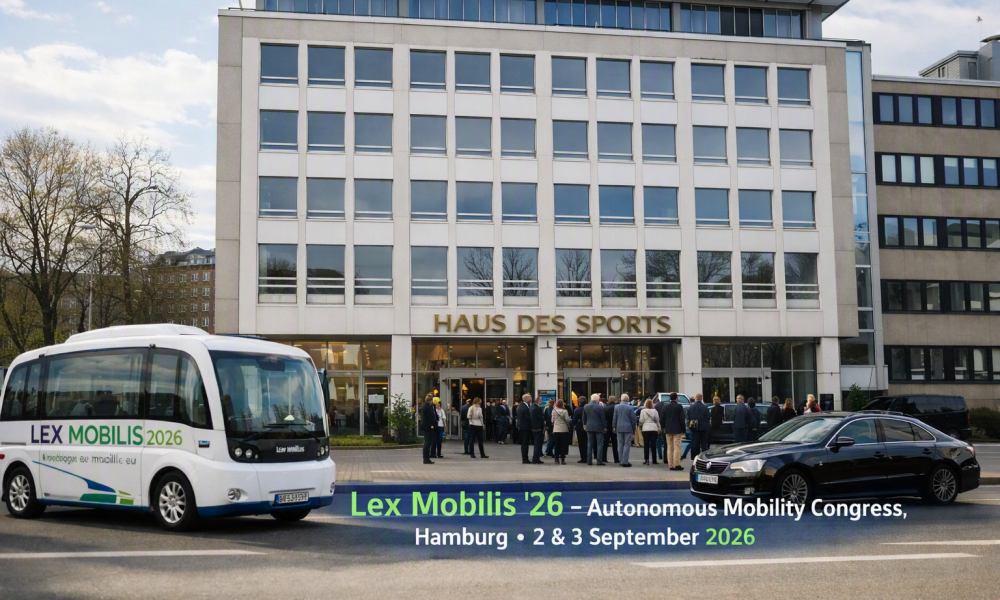
Lex Mobilis ’26 arrived in Hamburg at precisely the moment Europe’s autonomous mobility conversation needed a forum that could move beyond technical fascination and confront the realities of deployment. The two-day congress on 2nd and 3rd September brought together regulators, operators, lawyers, engineers and city leaders in a setting designed to dissolve the usual silos. The organisers framed the event as the place where law meets the street, which proved an accurate description of the tone throughout. Autonomous systems are no longer confined to pilot zones or carefully curated demonstrations. They are navigating real streets, serving real passengers and interacting with real infrastructure, yet the legal and operational frameworks that govern them remain uneven across Europe. Lex Mobilis set out to address that tension with a programme that blended policy, practice and technical insight in equal measure.
The opening morning established the scale of the challenge. Richard Damm of the KBA explored the current pathways to road traffic automation and highlighted the opportunities that arise when regulatory clarity aligns with technological maturity. His keynote made clear that Europe’s ambition for Level 4 systems will only be realised when approval processes become more predictable and when operators can rely on frameworks that reflect the complexity of automated behaviour. Professor Anne Paschke followed with a perspective on how cities and infrastructure will need to adapt as automation becomes part of everyday mobility. Her argument centred on the idea that autonomous systems will reshape urban form not through dramatic reinvention but through incremental changes that accumulate over time. The subsequent panel discussion brought these themes together, with contributions from Hamburg’s transport ministry and Volkswagen’s automated driving specialists, each emphasising the need for shared responsibility between regulators and operators.
The first afternoon session turned attention to the public sector’s role in approvals and operations. Paul Hannappel examined the AFGBV framework for Level 4 vehicles in Germany, presenting it as a foundation that can support deployment while still allowing for innovation. Tom Michael Gasser from BASt offered a pragmatic view of validation, stressing that sustained automated driving requires evidence that goes beyond isolated test results. Kirstin Hegner shared lessons from a dry run of operational domain approval, which illustrated how theoretical frameworks behave when confronted with real-world constraints. Justin Ziegenbein closed the session with reflections on shaping mobility systems in the emerging robotaxi age, noting that the transition from pilot to scale will depend on how cities integrate autonomous services into broader mobility strategies.
Industry perspectives dominated the second session. Andreas Leiting from HELLA explored explainable compliance and the challenge of turning traffic rules into operational assets. His contribution underscored the importance of transparency in automated decision-making, particularly when systems must demonstrate compliance in ways that regulators and operators can understand. Alexander Uedelhoven presented the SUE People Mover as an example of autonomous design built from the ground up rather than retrofitted onto existing platforms. Silvia Thal from Siemens Mobility drew parallels between Level 4 road systems and GoA 4 rail automation, suggesting that the two domains share more conceptual ground than is often assumed. Her argument hinted at a future where cross-sector learning accelerates progress in both fields.
The final session of the first day focused on standardisation and certification. Dr Frederic Geber examined the prospects for EU-wide type approval for autonomous driving and outlined the conditions under which such a framework could emerge. His analysis suggested that Europe is moving towards greater alignment, although national differences remain significant. Dr Hiroki Nakamura provided an international perspective through a review of Japan’s SAKURA project, which offers a structured approach to safety assurance for automated driving systems. The day concluded with a wrap-up from Steve Schneider of ITS mobility, who emphasised the importance of dialogue between those who set standards and those who work with them daily.
The second day opened with a renewed focus on political and regulatory perspectives. Dr Anjes Tjarks, Hamburg’s Senator for Transport and Mobility Transition, offered a city-level view of how autonomous systems can support broader mobility goals. His remarks highlighted the need for political leadership that understands both the promise and the complexity of automation. Henry Kuhle from the VDA followed with a keynote on regulation and market entry, posing the question of whether current frameworks act as enablers or obstacles. His argument suggested that Europe’s regulatory environment is capable of supporting innovation, provided that industry and government maintain a shared commitment to clarity and consistency. The morning panel discussion brought these viewpoints together, with contributions from Kirstin Hegner and other experts who stressed that successful deployment will require a balance between ambition and caution.
The remainder of the programme continued to explore the interplay between law, technology and operations. Sessions examined how operators can navigate approval processes that were not designed for autonomous behaviour, how standards can evolve to reflect the realities of mixed traffic environments and how certification can support cross-border deployment. The discussions revealed a sector that is ready to move beyond pilot projects but still grappling with the question of how to scale safely and economically. Lex Mobilis provided a forum where these issues could be confronted openly, without the usual separation between legal, technical and operational communities.
The congress also served as a reminder that autonomous mobility is not simply a technological challenge. It is a governance challenge, a legal challenge and an operational challenge. The organisers positioned the event as a place where these strands could be woven together, and the programme reflected that ambition. The presence of regulatory agencies, municipal utilities, law firms, operator organisations and research institutions created a dynamic environment where differing perspectives could be tested against one another. The result was a conversation that felt grounded in reality rather than speculation.
Lex Mobilis ’26 demonstrated that Europe’s autonomous mobility landscape is entering a new phase. The technologies have reached a level of maturity that allows for real deployment, yet the frameworks that govern them are still evolving. The congress provided a space where those responsible for shaping that evolution could meet, debate and refine their approaches. The discussions made clear that the future of autonomous mobility will depend on collaboration between those who write the rules and those who build the systems. The event’s emphasis on practical, legally sound and scalable operational concepts reflected a growing recognition that autonomous mobility must be treated as an integrated system rather than a collection of isolated innovations.
The two days in Hamburg offered more than a programme of keynotes and panels. They offered a glimpse of how Europe might navigate the next stage of autonomous mobility. The conversations were grounded in experience, informed by expertise and shaped by a shared desire to move from experimentation to implementation. Lex Mobilis ’26 succeeded in bringing together the communities that must work in concert if autonomous systems are to become part of everyday mobility. The event’s central message was clear. Europe’s autonomous future will be built not only through technological progress but through the careful alignment of law, regulation and operations. Lex Mobilis provided a forum where that alignment could begin to take shape.
Click the buttons below to see more articles:
See all ArticlesIndustry InsightEventsITS Thought LeadershipITS Educational