150x150.png)
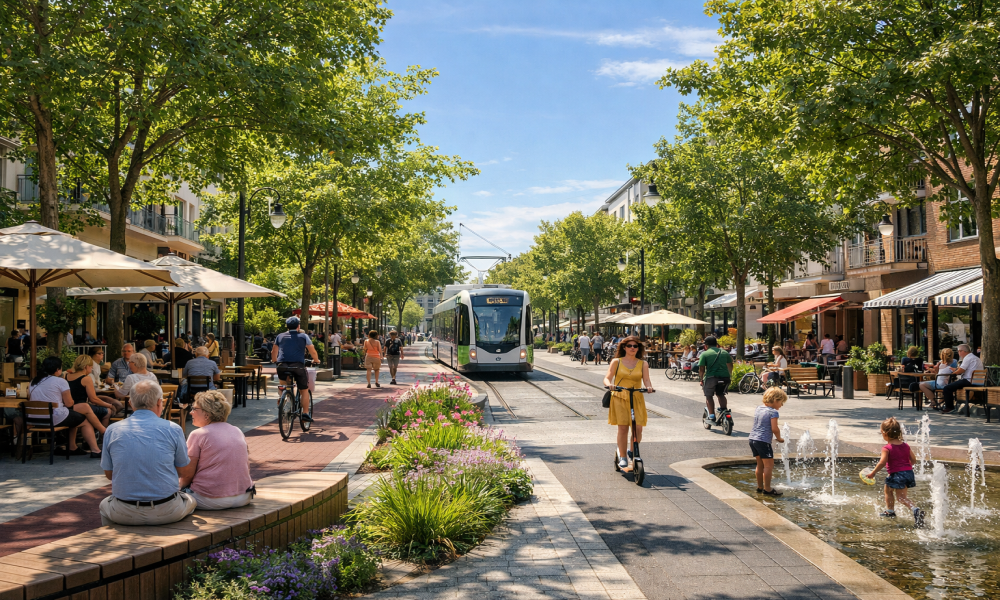
For years, the phrase “post-car city” has been tossed around like a provocation, a shorthand for everything from climate ambition to cultural rebellion. Strip away the manifesto posters and the architectural renderings with suspiciously blue skies, and a more interesting question emerges: What does a post-car city actually look like when it is built from evidence rather than ideology? Not a fantasy metropolis where every citizen cycles serenely to artisanal bakeries, but a functioning, economically credible, socially complex urban system that has simply moved beyond the private car as its organising principle.
The truth is that fragments of this future already exist. They are scattered across Europe, stitched into Asian megacities, emerging in North America, and quietly transforming the daily rhythms of millions of people. A post-car city is not hypothetical. It is already here, although unevenly distributed.
The first clue lies in the data from cities that have deliberately constrained car dominance. Paris, for example, has reduced car traffic by around 40% since 2001, not through a single grand intervention but through a steady layering of policies: protected cycle lanes, pedestrianisation, low-emission zones, and the reallocation of riverbank highways into public space. The cycling renaissance is real, but the behavioural shift is even more striking. Residents now make more short trips on foot, more medium trips by bike or e-bike, and more long trips by rail. The car has not vanished. It has simply lost its default status.
Copenhagen offers another evidence point. Its famous cycling culture did not materialise from cultural preference alone. It was engineered through decades of investment in separated cycle infrastructure, intersection design, and winter maintenance that treats cycle lanes with the same seriousness as roads. The result is a city where 62% of residents commute by bike, not because they are ideologically committed to it, but because it is the fastest and most reliable mode available. A post-car city is not anti-car. It is pro-efficiency.
Some of the most compelling examples come from places where the car was once utterly dominant. Pontevedra in Spain eliminated through-traffic from its centre, redesigned streets for walking, and saw road deaths fall to zero for more than a decade. Ghent’s circulation plan, introduced in 2017, restructured the city into zones that cars cannot easily traverse. Traffic evaporated, cycling doubled, and retail footfall increased. These are not wealthy capitals with vast budgets. They are mid-sized cities that treated mobility as a system rather than a cultural battleground.
This evidence reveals the anatomy of a post-car city. It is quieter, not in a romantic sense but in the measurable reduction of noise pollution. When Barcelona implemented its superblocks, noise levels dropped by up to 7 decibels in affected areas. That is not a marginal gain. It is a transformation in lived experience. Air quality improves rapidly. Low-traffic neighbourhoods in London have shown nitrogen dioxide reductions of 20–25% within months. Streets become more predictable. With fewer vehicles, conflict points reduce and vulnerable road users gain confidence. Safety becomes a statistical outcome rather than a slogan.
A post-car city is not defined by the absence of cars but by the presence of alternatives that outperform them. High-frequency buses running on dedicated lanes. Metro systems that are clean, safe, and frequent enough to eliminate timetable anxiety. On-street micromobility that is regulated, integrated, and maintained. Freight consolidated into electric vans and cargo bikes. Parking repurposed into housing, greenery, or commercial space. The car becomes one mode among many, not the backbone of urban life.
Technology plays a constructive role when it is treated as the connective tissue of a better mobility system rather than as a stand-alone solution. Real-time data, integrated ticketing, and MaaS platforms can help people compare and combine walking, cycling, buses, rail, shared mobility, and demand-responsive services into journeys that are easier, faster, and more reliable than defaulting to the private car. Digital twins and live network management can also help cities understand demand, coordinate freight and passenger flows, and allocate limited road space dynamically to the modes that move the most people, goods, and services with the least friction. In this sense, technology strengthens the physical redesign of streets: it supports smarter kerbside management, prioritises buses and emergency vehicles where space is constrained, improves interchange between modes, and makes the post-car city feel less restrictive by giving people more visible, practical choices.
Economically, the post-car city is surprisingly resilient. Retailers often fear pedestrianisation, yet the data repeatedly shows increased footfall and dwell time. Property values rise when streets become quieter and safer. Public health improves, reducing long-term costs. Employers benefit from more reliable commuting patterns. The shift is not a sacrifice. It is a rebalancing.
Socially, the picture is more complex. A post-car city must work for children, older adults, disabled people, shift workers, and those living in outer districts. Evidence from Vienna’s gender-sensitive planning shows that when cities design for diverse users, mobility networks become more inclusive. Bogotá’s TransMilenio demonstrates that bus rapid transit can serve low-income communities effectively when frequency and coverage are prioritised. The post-car city is not a playground for the affluent. It is a system that recognises mobility as a public good.
Culture also matters. Cities are emotional landscapes as much as physical ones. The car has been a symbol of autonomy for a century, and its decline requires a reframing of what freedom looks like. In Seoul, the removal of the Cheonggyecheon highway created a linear park that became a civic icon. In Milan, the Strade Aperte programme turned pandemic-era street reallocations into permanent features, shifting public perception of what streets are for. Culture follows infrastructure rather than the other way around.
The post-car city is not a utopia. It is a pragmatic, evidence-based evolution of urban systems. It is messier than the renderings, more incremental than the manifestos, and more grounded in human behaviour than in technological promise. It is a city where mobility is abundant rather than restricted, where streets are designed for people rather than machines, and where efficiency, safety, and sustainability align instead of competing.
The most important insight is that this city already exists in fragments, pilots, corridors, and districts. The challenge for the next decade is not to imagine it but to scale it. Lessons from Paris, Ghent, Copenhagen, Seoul, Bogotá, and dozens of others must be applied with local nuance. The post-car city is not a destination. It is a direction.
A post-car city is not defined by what it removes, but by what it enables: cleaner air, safer streets, more reliable journeys, more vibrant public spaces, and a mobility ecosystem that treats efficiency as a civic virtue. It is not the end of the car. It is the beginning of a more balanced urban future, built not on utopian sketches but on evidence, experience, and the quiet revolution already unfolding on streets around the world.
Click the buttons below to see more articles:
See all ArticlesIndustry InsightEventsITS Thought LeadershipITS Educational