150x150.png)
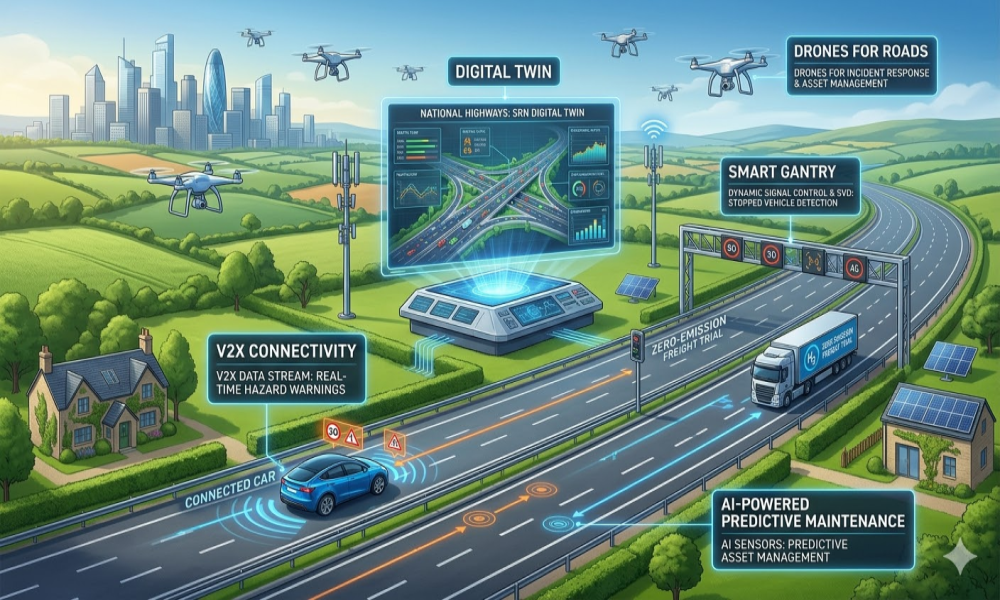
The UK Government has officially unveiled the third Road Investment Strategy (RIS3) today, marking a definitive shift in the management of England’s Strategic Road Network (SRN). Backed by a £27 billion funding package for the period of 2026–2031, the strategy signals an end to the "era of expansion" and the beginning of a "maintenance-first" philosophy.
Speaking in the House of Commons, Transport Secretary Heidi Alexander described the plan as a mission to "fix the foundations" of the nation's transport infrastructure. While the budget includes major commitments like the Lower Thames Crossing and the dualling of the A66, the true heartbeat of RIS3 lies in its digital ambition. For National Highways, the next five years will be defined by the transition from a physical infrastructure operator to a data-driven service provider.
In a significant pivot from previous road periods, RIS3 allocates an unprecedented £8.4 billion specifically for renewals. This isn't just about filling potholes, it represents a massive modernisation of the roadside technology that keeps the network functioning.
National Highways has identified that much of its legacy Intelligent Transport Systems (ITS) infrastructure, from variable message signs (VMS) to CCTV and incident detection sensors, is reaching the end of its design life. Under RIS3, this equipment will not just be replaced but upgraded to "smart" standards.
"We are tackling an aging network head-on", said Elliot Shaw, Executive Director of Strategy at National Highways, "modernising roadside technology is the only way to support safe, smooth journeys without the need for disruptive and expensive new lane construction".
At the core of RIS3 is the "Digital Roads" vision, which National Highways has been incubating for several years. The strategy is structured around three core themes that will dictate procurement and innovation through 2031:
1. Digital Design and Construction
National Highways aims to make Digital Twins the standard for all new projects and major renewals. By creating virtual replicas of the network, engineers can perform "digital rehearsals" of roadworks to identify potential conflicts before a single cone is placed.
Automated Construction: RIS3 accelerates the use of connected and autonomous plant (CAP) on construction sites to improve worker safety.
Modular Manufacturing: A move toward off-site, modular bridge and gantry construction to reduce on-road disruption.
2. Digital Operations
The goal for 2031 is a transition from reactive to predictive asset management.
AI and Machine Learning: National Highways will deploy AI to analyse data from thousands of sensors, predicting where a road surface might fail or where a vehicle is likely to break down before it happens.
Aerial Surveillance: The strategy confirms a wider rollout of the "Drones for Roads" program for rapid incident response and structural inspections, reducing the need for human inspectors to work at height or near live traffic.
3. Digital for Customers
Perhaps the most visible change for the public will be the shift in how information is delivered.
Connected Vehicle Integration: National Highways is moving toward a "signless" road vision where safety warnings and speed limits are delivered directly into the vehicle's dashboard via V2X (Vehicle-to-Everything) communication.
Personalised Data: RIS3 prioritises high-quality, real-time data feeds for third-party navigation apps (like Google Maps and Waze) to ensure drivers have consistent, trusted information about roadworks and delays.
While RIS3 has been criticised by some for a "woefully unambitious" new safety target, a 7.5% reduction in killed or seriously injured (KSI) casualties by 2031, National Highways maintains that technology is the key to reaching its ultimate goal of "Zero Harm" by 2040.
The Safety National Programme will see targeted ITS interventions on high-risk A-roads. This includes the deployment of more sophisticated stopped vehicle detection (SVD) systems and dynamic signal control to manage traffic flow during incidents. The strategy also includes a new Growth and Housing Accelerator Fund, using technology to unlock development sites where infrastructure constraints currently exist.
RIS3 is the first road strategy fully aligned with the UK’s Net Zero 2050 mandate. Technology is the primary lever here:
Rapid Charging Fund: National Highways will use RIS3 funding to ensure the SRN is ready for the mass adoption of electric vehicles (EVs), ensuring that every motorway service area has high-powered charging points.
Zero-Emission Freight: The strategy confirms ongoing trials for zero-emission HGVs, exploring both battery-electric and hydrogen solutions for the heavy logistics sector that relies so heavily on the SRN.
The investment is spread across the English regions, with over £4.4 billion earmarked for the North to support the Northern Growth Strategy. Key projects include:
The Midlands: Significant upgrades to the A46 at Newark, utilising smart signalling to support the region's dominant logistics sector.
The South: The Lower Thames Crossing remains the flagship project, designed as the UK's most "digitally advanced" road, featuring integrated C-ITS and carbon-neutral operation goals.
| Focus Area | Key Technology | Objective |
|---|---|---|
| Asset Management | Digital Twins & AI | Predictive maintenance and reduced "emergency" repairs. |
| Safety | V2X & SVD | 7.5% reduction in KSIs; faster incident clearance. |
| Sustainability | EV Charging & LED lighting | Support the transition to a zero-emission fleet by 2035. |
| Efficiency | Automated Design | 50% reduction in time taken for early-stage scheme design. |
RIS3 represents a pragmatic evolution. In an era of fiscal constraint and climate urgency, the UK government is betting on Intelligent Transport Systems to squeeze more capacity and safety out of existing asphalt. The message to the ITS industry is clear: the next five years will not be about building more, but about thinking better.
As National Highways begins the process of finalising its Strategic Business Plan for the 2026–2031 period, the focus now shifts to the supply chain’s ability to deliver the digital tools required to turn this vision into a reality.
Click the buttons below to see more articles:
See all ArticlesIndustry InsightEventsITS Thought LeadershipITS Educational