
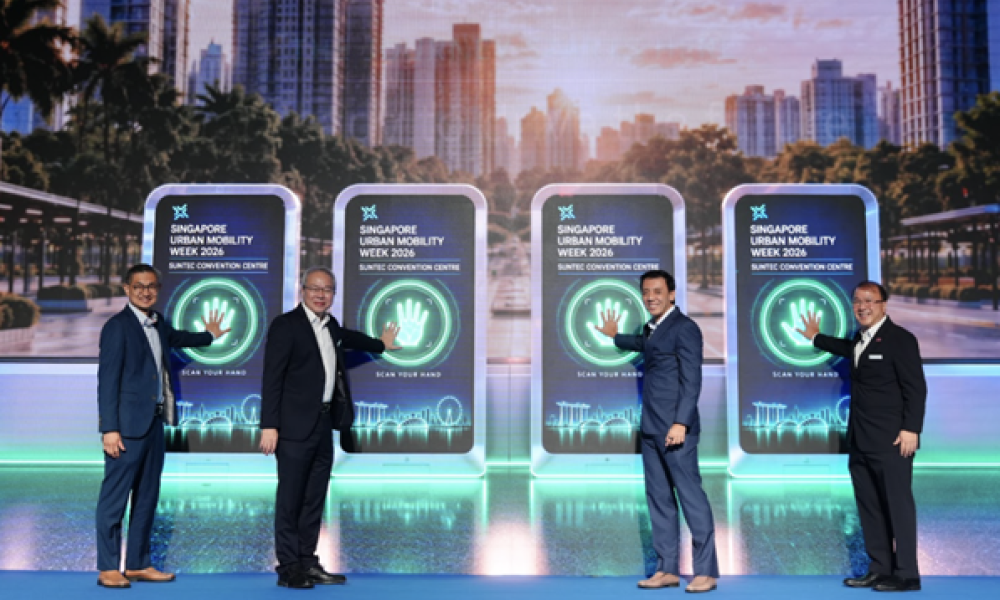
Singapore Urban Mobility Week has opened its inaugural edition with a clear sense of purpose. Hosted at the Suntec Singapore Convention & Exhibition Centre from 4-6 November, the event has positioned itself as a new focal point for discussions around autonomous innovation, smart infrastructure and the future of urban mobility across Asia Pacific and beyond. Organised by Singapore's Land Transport Authority alongside industry partners and supported by the Ministry of Transport, SUMW has attracted transport leaders, policymakers, operators, technology companies and researchers from around the world, all united by a common challenge: how to deliver mobility systems that are smarter, more sustainable and better connected for increasingly complex urban environments.
Day one established the strategic direction for the week. Proceedings began with the official opening ceremony, where Guest of Honour Jeffrey Siow, Singapore's Minister for Transport and Senior Minister of State for Finance, outlined the country's vision for future mobility. His address reinforced Singapore's longstanding reputation as a nation willing to invest for the long term, viewing transport not simply as infrastructure but as an essential enabler of economic competitiveness, social inclusion and quality of life.
That opening tone carried through the Leaders Summit, which focused on some of the most pressing questions facing transport authorities and mobility providers worldwide. Rather than concentrating solely on technology, discussions repeatedly returned to the passenger experience and the importance of designing systems around people's everyday journeys.
The first major theme examined the future of mobility through the lens of the commuter. Conversations explored how accessibility, integrated planning and thoughtful urban design can remove many of the barriers that still exist within contemporary transport networks. This focus on seamless travel is increasingly relevant for Intelligent Transport Systems professionals, as the industry recognises that technology delivers its greatest value when it supports genuinely frictionless multimodal journeys.
Attention then shifted towards the challenge of infrastructure renewal and digital transformation. Under the theme "Beyond the Tracks", industry leaders considered how ageing rail assets can be modernised while maintaining service reliability. Digitalisation featured prominently throughout these discussions, reflecting a growing recognition that asset management, predictive maintenance, condition monitoring and operational optimisation are becoming fundamental components of modern transport strategies rather than optional enhancements.
Workforce development formed another important pillar of the day. Discussions on building the human edge in transport highlighted a reality often overlooked amid excitement surrounding automation and artificial intelligence. Delivering future mobility systems will require not only new technologies but also new skills. Reskilling existing staff, developing future talent and creating pathways into emerging technical disciplines are becoming strategic priorities for transport agencies globally.
Autonomous mobility completed the quartet of headline themes. Sessions examining autonomous vehicles in high-density cities moved beyond theory and towards practical deployment considerations. Questions around regulation, safety assurance, fleet operations, infrastructure readiness and public acceptance illustrated just how much groundwork remains necessary before large-scale autonomous transport becomes commonplace. At the same time, the discussion demonstrated how rapidly the sector is progressing from experimentation towards operational implementation.
Across the exhibition floor, delegates were able to connect these strategic themes with tangible solutions. Companies from across the mobility ecosystem showcased developments in intelligent transport systems, electrification, automation, digital infrastructure and asset management. Conversations between exhibitors, transport authorities and operators appeared every bit as important as the formal conference programme, with new partnerships emerging through meetings, demonstrations and technology showcases.
The exhibition also provided a setting for a series of memorandum of understanding signings, reflecting the collaborative spirit that underpins many successful mobility initiatives. As transport challenges become increasingly interconnected, cooperation between public authorities, operators, technology providers and researchers continues to grow in importance.
Networking continued into the evening at Gardens by the Bay, where delegates gathered for the Industry Networking Night. Such events often provide the setting for some of the most valuable conversations of the week, creating opportunities for relationships to develop across geographical and organisational boundaries.
While day one focused largely on strategic leadership and long-term vision, day two promises to move deeper into the practical realities of implementation.
The Industry Forums now take centre stage, bringing together technical experts, operators, policymakers and solution providers to explore specific areas of transport innovation. This shift from high-level vision to detailed execution is likely to prove particularly valuable for ITS professionals seeking lessons that can be applied directly within their own organisations.
One of the most anticipated themes is integrated mobility operations, an area that sits at the heart of modern Intelligent Transport Systems. As cities seek to integrate public transport, shared mobility services, demand-responsive transport and active travel options into cohesive ecosystems, the ability to collect, process and act upon data in real time becomes increasingly important. Expect discussions around operational integration, data sharing, command and control systems, passenger information platforms and the technologies that enable seamless multimodal journeys.
Bus electrification is also set to feature prominently. The transition towards zero-emission public transport fleets remains a major focus for cities worldwide, yet the process involves much more than simply replacing diesel vehicles with battery-electric alternatives. Issues surrounding charging infrastructure, depot operations, energy management and lifecycle costs are likely to generate significant discussion. For transport authorities navigating their own decarbonisation pathways, practical insights from operators already progressing through this transition could prove invaluable.
Rail innovation remains another key priority. Sessions addressing autonomous train control systems will explore how advances in automation can improve safety, capacity and operational efficiency. These discussions align closely with broader ITS objectives around network optimisation, predictive operations and enhanced passenger service delivery.
Battery safety is expected to attract considerable interest, particularly given the rapid growth of electric mobility. As electrification expands across public transport fleets, private vehicles and micromobility services, understanding the safety implications of battery technologies becomes increasingly important. Transport agencies and operators alike must address public confidence alongside technical performance.
Infrastructure sustainability provides another major thread running through the day. Across Asia and globally, transport authorities face mounting pressure to deliver resilient infrastructure capable of supporting both current mobility needs and future technological developments. Expect discussion around sustainable construction practices, smart infrastructure deployment, digital twins, asset lifecycle management and climate resilience.
Perhaps one of the most significant areas for the ITS community will be the exploration of future mobility payments. Payment systems are often overlooked compared with more visible technologies, yet they play a crucial role in shaping travel behaviour and user experience. Advances in integrated ticketing, account-based systems, contactless payments and mobility-as-a-service platforms continue to redefine how passengers interact with transport networks. The evolution of these systems has implications extending far beyond fare collection, influencing everything from accessibility and inclusivity to data-driven network planning.
What emerges most clearly from the first day of SUMW is that urban mobility is no longer being viewed through isolated lenses of roads, railways, buses or technology. Instead, there is growing recognition that successful mobility systems depend upon the integration of all these elements into connected ecosystems centred on the needs of citizens.
As discussions continue into day two, Singapore Urban Mobility Week appears well positioned to fulfil its ambition of becoming a leading forum for mobility innovation in the Asia Pacific region. The conversations underway are not simply about future possibilities. They are increasingly focused on the practical steps required to transform ambitious visions into operational realities.
For ITS professionals, that balance between strategic aspiration and implementation detail may prove to be one of the event's most valuable contributions. The future of mobility is no longer a distant concept. In Singapore this week, it is being actively designed, debated and, increasingly, delivered.
Click the buttons below to see more articles:
See all ArticlesIndustry InsightEventsITS Thought LeadershipITS Educational