150x150.png)

The inaugural Intelligent Transport Systems UK's SafetyTech Forum was held in Birmingham. In a sector accelerating toward automation, electrification and data driven mobility, safety is no longer a compliance box to tick, it is the strategic foundation upon which every credible transport innovation must stand. Over two days, the Forum brought together system designers, highway authorities, vehicle manufacturers, software engineers and policy specialists to examine how Intelligent Transport Systems (ITS) can deliver safer, more resilient mobility networks in an era defined by complexity.
What emerged from Birmingham was a portrait of a sector that understands the stakes. Safety is no longer the quiet partner to innovation, it is the engine room. And the SafetyTech Forum made that abundantly clear.
The opening keynote set the tone, safety is not a constraint on innovation, it is the enabler. With automation maturing, connected vehicles proliferating and digital infrastructure becoming the nervous system of modern mobility, the Forum argued that safety must be embedded at the architectural level, not retrofitted as an afterthought.
This shift was evident across the programme. Whether discussing AI driven risk modelling, roadside sensor fusion or the ethics of automated decision making, speakers returned repeatedly to the same point, that the future of mobility will be judged not by how fast it arrives, but by how safely it operates.
One of the strongest themes to emerge from Birmingham was the rise of predictive safety intelligence, systems that anticipate risk rather than simply respond to it.
Several exhibitors showcased real time hazard prediction engines that combine roadside sensors, vehicle telemetry and environmental data to forecast collision likelihood minutes before an incident occurs. These systems are already being trialled on UK motorways, where early results show significant reductions in secondary collisions and hard braking events.
A standout session explored AI enhanced near miss analytics, using computer vision to detect unsafe behaviours at junctions, crossings and bus stops. Rather than waiting for collisions to occur, authorities can now intervene based on behavioural patterns, a shift that could transform urban safety planning.
Another panel examined the role of edge AI in safety critical environments. With connected vehicles generating vast data volumes, processing everything in the cloud is neither fast nor reliable enough for split second safety decisions. Edge based inference, running models directly on roadside units or in vehicle processors, is emerging as the only viable path for real time safety assurance. Predictive safety is no longer experimental. It is operational and it is reshaping how authorities think about risk.
Connected vehicle safety has been a recurring theme in UK mobility circles for years, but Birmingham marked a turning point. The conversation has shifted from pilot projects to deployment strategies.
The Forum highlighted three major developments:
The consensus is that connected vehicle safety is no longer a technology problem, it is a deployment, governance and interoperability challenge.
Automation featured prominently throughout the Forum, but with a refreshingly grounded tone. Rather than debating hypothetical Level 5 futures, speakers focused on the messy, human centred realities of deploying automated systems in mixed traffic.
A compelling panel explored human trust in automated decision making, highlighting research showing that passengers and road users respond more positively to automation when systems communicate their intent clearly. Visual cues, external HMI and predictable behaviour patterns were all cited as essential for public acceptance.
Another session examined handover risk, the moment when control shifts between human and machine. With partial automation becoming more common in commercial fleets, the Forum emphasised the need for robust driver monitoring, fatigue detection and training frameworks.
Perhaps the most striking insight came from a study showing that automation can unintentionally increase risk if drivers over trust the system. The Forum’s takeaway was unequivocal: automation must be introduced with behavioural science at its core.
Road worker protection has become a national priority and Birmingham showcased some of the most advanced solutions yet deployed in the UK.
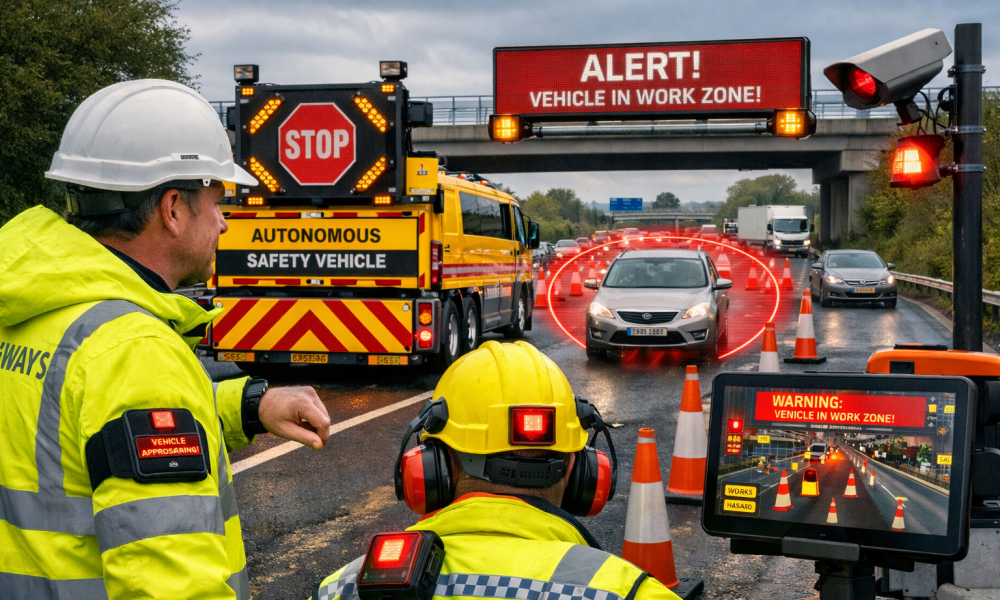
The Forum made it clear that technology is no longer optional in work zone safety. It is the difference between risk and resilience.
As transport systems become more connected, the attack surface grows. Birmingham devoted significant attention to cybersecurity, with sessions exploring:
One speaker captured the mood succinctly: “A system cannot be safe if it is not secure.”
The SafetyTech Forum in Birmingham offered a snapshot of a sector that has matured. Safety is no longer a compliance exercise or a regulatory hurdle. It is the organising principle of modern mobility.
Across AI, automation, connected vehicles, freight, road worker protection and cybersecurity, the Forum showcased a transport ecosystem that understands its responsibilities and is building the tools to meet them.
Click the buttons below to see more articles:
See all ArticlesIndustry InsightEventsITS Thought LeadershipITS Educational