150x150.png)
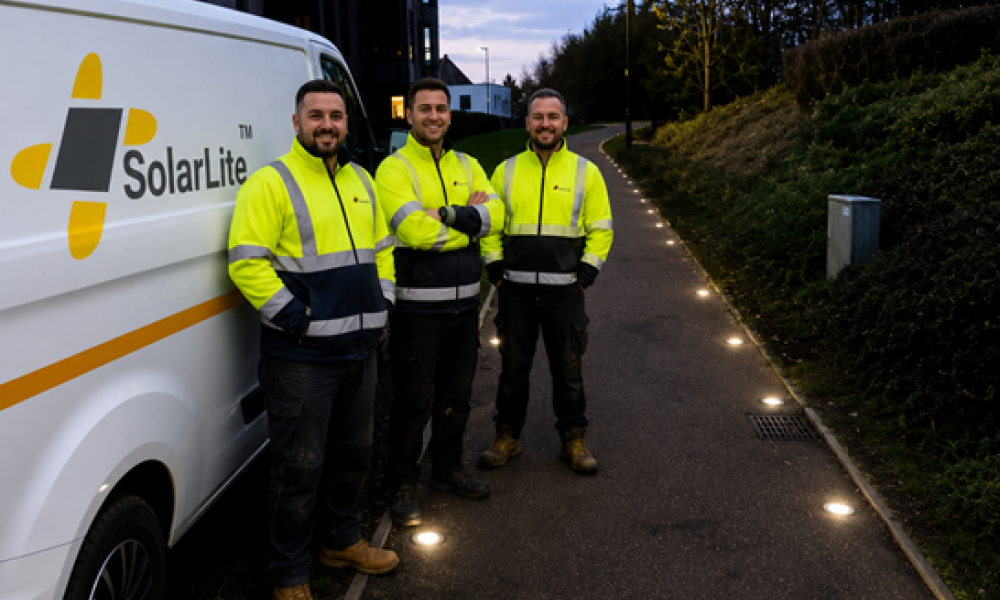
The UK’s highways sector has grown accustomed to innovation arriving in carefully managed phases, often through pilots, trials or incremental upgrades. Occasionally, however, a scheme emerges that invites authorities to step forward with their most stubborn problems and offers a practical solution without the usual financial barriers. The SolarLite Local Authority Impact Challenge sits firmly in that category. It is a rare opportunity for councils to secure a fully funded active road stud installation at locations where conventional measures are struggling to deliver the safety, performance or sustainability outcomes that communities expect.
SolarLite, working in partnership with the Local Council Roads Innovation Group, is inviting authorities to nominate sites where solar powered active road studs could make a measurable difference. The challenge will select three locations across the country and provide up to one hundred SolarLite studs at each site, together with standard installation at no cost. It is a straightforward proposition. Councils identify a problem. SolarLite and LCRIG provide the technology. The sector gains new evidence about where active studs can deliver the greatest impact.
The organisers are clear that they want to hear about genuinely difficult locations. Many councils have stretches of rural road that remain collision hotspots despite repeated interventions. Others are grappling with junctions or roundabouts where poor delineation contributes to erratic driver behaviour. Some are facing spiralling costs associated with ageing street lighting assets that no longer justify their carbon output or maintenance burden. These are precisely the types of sites the challenge hopes to uncover. The intention is not to reward the neatest submission. It is to find places where active studs could change outcomes in a way that is visible, quantifiable and replicable.
Entries open today and will remain live until the end of November. Applicants will be asked to provide essential information about the chosen site, the nature of the problem and the improvements they hope to achieve. A judging panel drawn from the Department for Transport, ADEPT, LCRIG, Highways News and SolarLite will assess the submissions. Successful authorities are expected to be notified before Christmas, with installations planned between January and March next year.
SolarLite’s Head, Alastair King, believes the challenge will surface issues that have persisted for years. He notes that many councils have locations where traditional retroreflective studs or conventional lighting simply cannot deliver the clarity or reliability required. He also highlights the growing number of authorities exploring lower carbon approaches to network safety. SolarLite’s active studs operate independently of mains electricity, using solar energy collected during daylight hours. They emit their own light through integrated LEDs and can be visible from up to nine hundred metres. Conventional studs typically rely on vehicle headlights and are visible from around ninety metres. The difference is not subtle. It changes how drivers perceive the road ahead, particularly in unlit or partially lit environments.
The challenge arrives at a moment when active stud technology is gaining renewed attention across the sector. Earlier this year, ADEPT published the final report from the Live Labs 2 decarbonising street lighting project led by East Riding of Yorkshire Council. More than five thousand active studs were installed across a series of test sites as part of new visual guidance designs intended to support the removal of conventional street lighting at selected locations. The results were striking. The project identified potential ten-year savings of more than one million pounds compared with traditional street lighting replacement. It also calculated a twenty-five per cent reduction in carbon over the same appraisal period, with the possibility of reaching thirty-six per cent through further value engineering.
The behavioural findings were equally notable. Initial monitoring recorded speed reductions at three quarters of the test sites, with some locations seeing reductions of up to ten per cent. Nighttime collision rates also fell compared with the previous year. The project team stressed that longer term monitoring would be required to understand the full picture, yet the early evidence was encouraging. It demonstrated that active studs can influence driver behaviour in ways that support both safety and sustainability objectives.
SolarLite intends to build on that evidence. Mr King emphasises that the challenge is fundamentally about data. The company wants to quantify the problem at each selected site and demonstrate, through before and after monitoring, whether active studs deliver measurable improvements. He hopes the initiative will encourage authorities that have heard about active studs but never trialled them to put forward their most difficult locations. He believes the challenge will help councils move from curiosity to practical deployment.
LCRIG sees the partnership as an opportunity to support innovation in a way that aligns with the realities facing local authorities. Relationship Director Susanne Ingham notes that councils are under increasing pressure to improve road safety, make best use of limited resources and deliver more sustainable solutions. She believes the challenge provides a platform for authorities to test new approaches and build an evidence base around what works. She also highlights the importance of sharing learning with the wider highways community, ensuring that insights from the three installations can inform future strategies across the sector.
While SolarLite is now established as a specialist brand, its technology has a long heritage. Solar powered road studs have been developed and delivered by Clearview Intelligence since the 1990s, with installations on both local and strategic roads in the UK and overseas. Major deployments on the A2, A20, M25 and M40 sit alongside applications on rural roads, active travel routes and level crossings. The technology is proven. The challenge aims to expand its application into locations where councils need a fresh approach.
The three winning schemes will be monitored following installation, allowing SolarLite and participating authorities to assess their effect on vehicle speeds, driver behaviour, safety, energy use and whole life costs. Findings will be shared with the sector, including through SolarLite’s Stud for Thought series. The organisers hope the challenge will not only deliver improvements at the selected sites but also contribute to a broader understanding of where active studs can offer the greatest value.
Local authorities can enter the SolarLite Local Authority Impact Challenge through the LCRIG website.
Click the buttons below to see more articles:
See all ArticlesIndustry InsightEventsITS Thought LeadershipITS Educational