150x150.png)
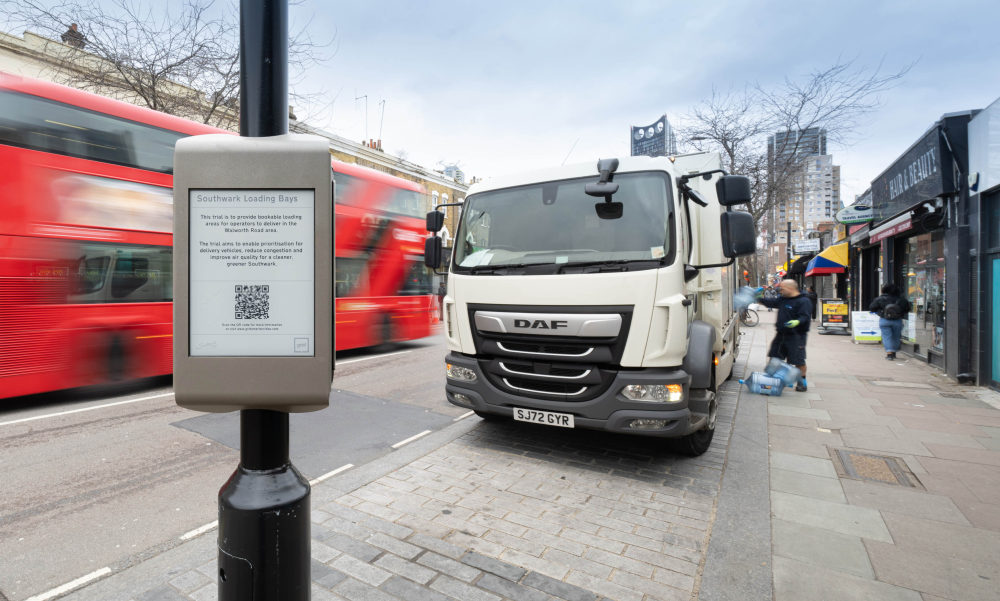
Urban freight is a constant negotiation for space. Every street becomes a shared stage where delivery vans, cyclists, pedestrians, buses, taxis and bin lorries move through narrow corridors that were never designed for modern logistics. The kerbside is often the most contested part of that stage. It is where legality, practicality and urgency meet, and where drivers must make quick decisions that shape the rhythm of their working day. For many, the simple act of finding somewhere lawful to stop is one of the most stressful moments of any delivery round.
New academic research from Sweden has begun to quantify that experience. The study, presented at the City Logistics 2025 conference and published in Transportation Research Procedia, examined a pilot of Grid Smarter Cities’ Virtual Loading Bay technology around London’s Borough Market. It offers a detailed look at how uncertainty over kerbside access affects driver wellbeing, and how digital tools might help cities manage their limited road space more intelligently.
The research team from Chalmers University of Technology and the University of Gothenburg monitored seventeen delivery trips carried out by two freight operators between November and December 2024. This was not a simple observational exercise. Drivers and co-drivers wore body sensors that measured heart rate, skin temperature and physiological stress indicators. They completed surveys before and after their rounds. GPS traces were combined with biometric data to identify where stress levels rose and fell during each journey. The result is one of the most granular examinations of urban freight operations yet published.
Although the sample size was modest, the findings are revealing. Searching for legal loading space emerged as a clear contributor to stress. One monitored driver spent twenty minutes circling Borough Market in search for a place to stop. He eventually parked in a restricted area and received a Penalty Charge Notice. His physiological stress levels rose during the search and remained elevated afterwards. Across all monitored trips, average stress scores during delivery operations were consistently higher than drivers’ resting levels.
The researchers emphasise that stress is shaped by a wide range of factors. Traffic conditions, freight volumes, seasonal demand, road layout and time pressure all influence how drivers feel behind the wheel. Kerbside uncertainty is only one part of a complex picture. Even so, the study highlights how the unpredictability of urban streets can amplify the pressures of delivery work.
Grid Smarter Cities’ Virtual Loading Bay system allows drivers to pre-book loading bays for up to ninety minutes. The intention is to reduce circling, cut unnecessary miles and give drivers confidence that a legal space will be available when they arrive. The research found that the booking system reduced uncertainty. Drivers knew where they were going and knew they had a legal space waiting for them. They did not need to gamble on finding somewhere to stop. In a sector where minutes matter and margins are tight, that certainty is valuable. The authors suggest that wider deployment of bookable loading bays, not just isolated pilots but full-route coverage, could amplify the benefits. A single bookable bay helps at one point in a journey. A network of them could reshape the entire delivery experience.
The study’s conclusions align with a growing recognition across the transport and ITS community. Kerbside space is one of the most constrained resources in cities. It is also one of the least intelligently managed. For decades, kerbsides have been treated as static infrastructure with fixed signs, fixed restrictions and fixed expectations. Demand, however, is anything but static. Freight peaks in the morning. Ride-hail peaks at night. Micro-mobility ebbs and flows throughout the day. Waste collection, construction deliveries, bus operations and emergency access all compete for the same narrow strips of asphalt.
Digital kerbside management reframes the kerb as dynamic space. Bookable loading bays, flexible restrictions, real-time availability and integrated enforcement create a system where access can be allocated based on need rather than guesswork. For freight drivers, this means fewer stressful searches. For cities, it means fewer conflicts, safer streets and more efficient use of limited space.
The Swedish researchers argue that digital kerbside management should be viewed not simply as a logistics tool but as part of a wider approach to reducing conflict over road space. It is a safety intervention, a wellbeing intervention and a space-management intervention. It supports the people who keep urban freight moving and helps create streets that work more harmoniously for everyone who uses them.
Technology is increasingly recognised as something that must support people rather than simply optimise processes. Digital twins, automation, AI-driven routing and kerbside platforms all have human consequences. Understanding those consequences is essential if cities want to build freight systems that are safe, sustainable and socially responsible.
Grid Smarter Cities already operates bookable loading bays in other parts of London, including the award-winning scheme on Walworth Road. As more cities explore digital kerbside management, the evidence base will grow. Larger studies, multi-operator trials and long-term monitoring could reveal how stress patterns change when digital tools are deployed at scale.
For now, the Swedish research offers a clear message. Uncertainty over kerbside access is a real source of stress for freight drivers, and digital management tools can help reduce that uncertainty. They are not a complete solution, yet they form an important part of a wider response. They treat kerbside space as precious, drivers as central to urban logistics and technology as a means to support both.
Urban freight keeps cities functioning. The people behind the wheel deserve streets that work with them rather than against them. Digital kerbside management will not remove every pressure, yet it can make the daily rhythm of deliveries more predictable, safer and less stressful.
Click the buttons below to see more articles:
See all ArticlesIndustry InsightEventsITS Thought LeadershipITS Educational