150x150.png)
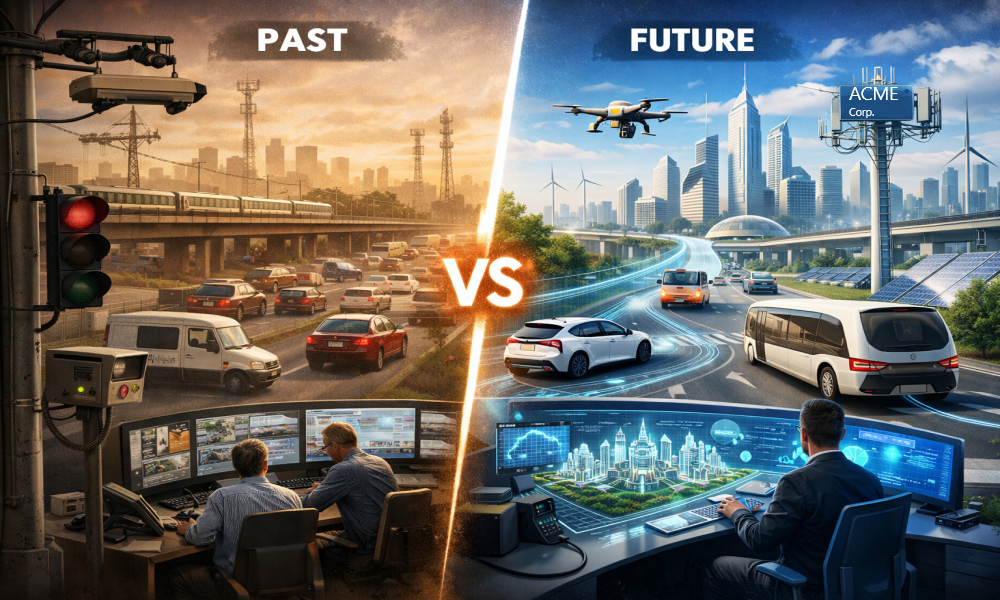
The Intelligent Transport Systems sector has always evolved in cycles. Periods of rapid innovation, often driven by small specialist firms, are followed by phases of integration, standardisation and consolidation. Over the past two years, that consolidation phase has accelerated sharply. Across Europe, North America and Asia, the number of independent ITS suppliers is shrinking as mergers, acquisitions and strategic partnerships reshape the market. What was once a diverse ecosystem of niche providers is becoming a tighter field dominated by larger groups with global reach. The question now is whether this consolidation strengthens the sector or risks stifling the creativity that has long defined it.
The drivers behind this shift are not mysterious. Cities and national transport agencies increasingly demand end-to-end solutions rather than standalone products. A modern traffic management system is no longer just a signal controller or a roadside sensor. It is a cloud-based analytics platform, a multimodal data engine, a cybersecurity-hardened network and a suite of connected services that must integrate seamlessly with public transport, enforcement, freight and emerging mobility providers. Delivering all of that requires scale, capital and technical breadth. Smaller firms, however innovative, struggle to compete with global integrators who can offer a single procurement route and long-term support.
This pressure has created fertile ground for acquisitions. One of the clearest examples is the continued expansion of Yunex Traffic, which has absorbed regional integrators across Europe to strengthen its position in traffic management, enforcement and connected vehicle services. Its acquisition of Aimsun brought simulation, modelling and digital twin capability under one roof, creating a vertically integrated portfolio that few independent firms could match. Similarly, Iteris in the United States has consolidated its position by acquiring smaller analytics and sensor companies, building a comprehensive ecosystem around smart intersections and multimodal optimisation.
Private equity has also entered the sector with new intensity. ITS is increasingly viewed as a long-term infrastructure play rather than a niche technology market. Investors prefer consolidated portfolios over fragmented supplier landscapes, and they are actively encouraging mergers to create larger, more stable entities. The acquisition of PTV Group by Porsche SE, followed by PTV’s merger with Econolite, is a prime example. What began as a modelling software company is now part of a transatlantic ITS powerhouse combining traffic control, simulation, routing and mobility analytics. The result is a supplier with enormous reach, but also one fewer independent player in a market that once thrived on diversity.
Europe has seen similar patterns in enforcement and roadside technology. Sensys Gatso, already a major global enforcement supplier, has expanded through targeted acquisitions to secure market share in automated speed and red-light enforcement. In the UK, consolidation among ANPR and enforcement providers has reduced the number of independent firms capable of competing for large police and local authority contracts. In Scandinavia, several mid-sized ITS companies have merged to create regional champions capable of bidding for national digital mobility programmes.
These examples are not isolated. They form a pattern that is reshaping the global ITS landscape. Procurement practices are reinforcing the trend. Public authorities increasingly favour fewer, larger contracts to reduce administrative overhead and perceived risk. A single supplier delivering hardware, software, cloud services and maintenance is easier to manage than a constellation of smaller firms. But this convenience comes at a cost. When procurement consolidates, competition narrows. When competition narrows, innovation can slow.
The ITS sector has historically relied on small, agile companies to push boundaries. Many of the technologies now considered mainstream, such as adaptive signal control, real-time multimodal data fusion, roadside AI cameras, and connected vehicle messaging, began in small firms that specialised in one thing and did it exceptionally well. As these firms are absorbed into larger groups, their innovation pipelines often become subject to corporate priorities, shareholder expectations and global product strategies. Creativity becomes less about experimentation and more about alignment.
This does not mean consolidation is inherently negative. Larger suppliers can deliver stability, interoperability and long-term investment that smaller firms cannot. They can support national deployments, guarantee cybersecurity compliance, and integrate systems across borders. They can invest in digital twins, AI-driven optimisation and cloud-native architectures at a scale that would be impossible for independent companies. For cities and transport agencies, this can be reassuring. A consolidated supplier landscape can reduce fragmentation, improve standards and accelerate deployment.
But the risks are real. A shrinking supplier base can reduce choice, weaken bargaining power and create dependencies that are difficult to unwind. Innovation may become incremental rather than disruptive. Procurement may become less competitive. The sector may lose the diversity of thought that has always been its engine.
Competition authorities are beginning to take notice. The European Commission has already examined several mobility-tech acquisitions for potential market concentration impacts. National transport ministries in Germany, France and the UK have raised concerns about the long-term implications of consolidation in enforcement, traffic management and connected vehicle services. In the United States, the Federal Trade Commission has monitored acquisitions in the smart infrastructure sector for similar reasons. None of these interventions have halted consolidation, but they signal growing awareness that the ITS supplier landscape is changing in ways that may require oversight.
The next wave of consolidation may be driven by AI. As traffic systems become more predictive, more autonomous and more integrated with city-wide digital twins, suppliers will need massive datasets, cloud infrastructure and machine-learning capability. This favours large players. Smaller firms may struggle to compete unless they specialise in highly niche areas or become acquisition targets themselves. The same dynamic is emerging in connected vehicle ecosystems, where scale is essential for interoperability and safety.
The ITS sector is entering a new era. The consolidation wave is real, measurable and accelerating. It is reshaping how innovation happens, how procurement works and how competition is maintained. The challenge for the industry is to ensure that consolidation does not come at the expense of creativity, whilst for public authorities is to maintain competitive procurement environments even as supplier numbers shrink. At the same time, smaller firms will need to find ways to thrive in a market where scale increasingly determines survival.
Whether consolidation ultimately strengthens or weakens the sector will depend on how the industry responds. But one thing is clear. The ITS landscape of the next decade will look very different from the one that defined the last.
Click the buttons below to see more articles:
See all ArticlesIndustry InsightEventsITS Thought LeadershipITS Educational