150x150.png)
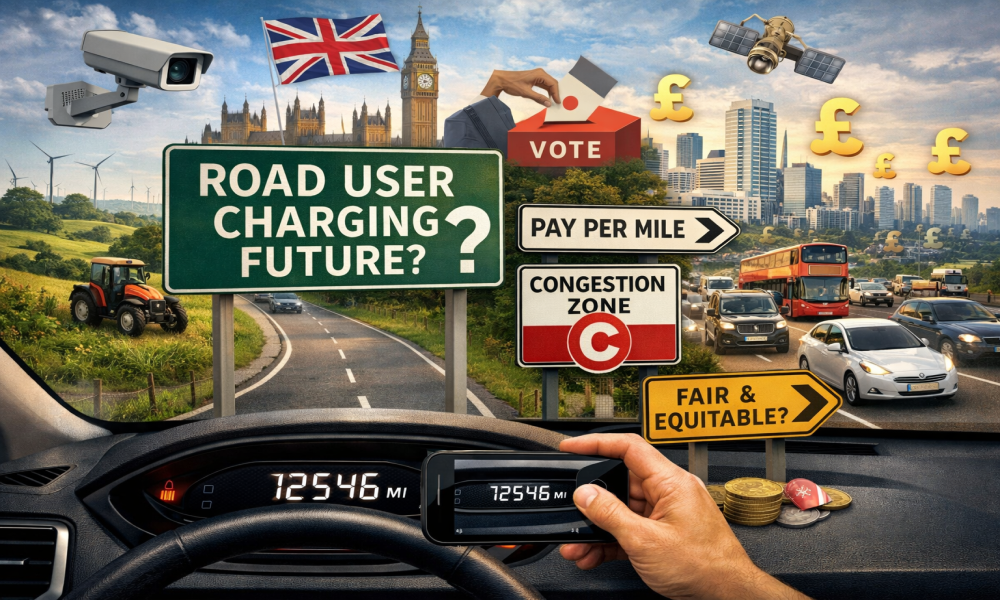
For more than a century, Britain has funded its roads through a simple, elegant mechanism, fuel duty. Every litre of petrol or diesel bought at the pump quietly contributed to the Treasury and in turn (at least in theory), helped maintain the network that keeps the country moving. It was predictable, politically convenient and largely invisible to the public. But as the UK accelerates towards electrification, that model is collapsing. The question is no longer whether we need a replacement, it’s how we design one that the public will accept, politicians will defend and society will consider fair.
This is where Road User Charging (RUC) re-enters the national conversation. Not as a fringe idea, not as a pilot scheme in a single city, but as a structural necessity. Yet the technology is the easy part. The real battle will be political, cultural and deeply emotional.
Westminster has tiptoed around RUC for years. Ministers know that fuel duty revenues which historically are worth £25–30 billion annually, will evaporate as electric vehicles become the norm. They also know that replacing that revenue requires a mechanism that charges people for the distance they drive, the places they drive or the time they drive. But saying this out loud is electoral poison.
The politics are brutally simple:
This is why the UK has seen a decade of “exploratory studies”, “consultations” and “future mobility frameworks”, all carefully avoiding the phrase road pricing. The Treasury wants a solution. The Department for Transport wants a solution. Local authorities want clarity. But no one wants to be the first to step into the political firing line.
The irony is that the longer the government waits, the harder the transition becomes. Every year of delay increases the revenue gap, increases the scale of public confusion and increases the likelihood that the eventual solution will be rushed, unpopular and poorly communicated.
If the politics are difficult, public acceptance is even harder. The UK has a deep trust deficit when it comes to transport policy. From ULEZ controversies to LTNs to bus lane enforcement, many communities feel that transport interventions are done to them rather than with them. Road user charging risks becoming the next flashpoint.
The public’s concerns fall into three broad categories:
1. Privacy - People worry that RUC means the government tracking their movements. Even if the system doesn’t require location data, the perception alone is enough to trigger resistance. The UK has a long cultural memory of surveillance debates (from ID cards to CCTV), and RUC risks being framed as “the state watching where you drive”.
2. Fairness - Motorists already feel financially squeezed. Insurance premiums are rising. Vehicle costs are rising. Parking charges are rising. Many will therefore ask why they should have to pay more simply because they’ve switched to cleaner vehicles? Without a clear narrative about fairness, RUC will be seen as punishment rather than reform.
3. Complexity Fuel duty is simple. You fill up, you pay. RUC must feel equally intuitive. If the public believes it will involve apps, accounts, devices, inspections or bureaucratic hurdles, acceptance will collapse.
This is why communication will matter more than technology. The public needs to hear (repeatedly, clearly and credibly), that RUC is not a penalty for driving, but a replacement for a tax that is disappearing. They need to understand that without it, the roads they rely on cannot be funded. And they need to see that the system is designed around fairness, not revenue extraction.
Equity is the most important and most neglected part of the RUC debate. Fuel duty, for all its flaws, is broadly progressive, with those who drive more paying more and those who drive less paying less. But electrification complicates this.
Electric vehicles are disproportionately owned by higher-income households. They pay no fuel duty. Meanwhile, lower-income households, including those in rural areas, often reliant on older petrol or diesel cars, will continue to pay. The current system is becoming regressive.
A well-designed RUC system could correct this imbalance. But only if equity is built in from the start. That means:
If RUC is framed as a fairness reform and not a tax grab, it stands a chance of public acceptance. But that requires political courage and a willingness to confront uncomfortable truths about who currently pays for Britain’s roads.
This is the deceptively simple question that cuts through the noise. Could the UK adopt a low-tech, low-intrusion, privacy-preserving model where drivers simply submit an annual odometer reading (perhaps with a photo), and pay based on miles driven?
Technically, yes. Politically, it’s attractive. Publicly, it’s understandable. And from an equity perspective, it’s neutral.
But it has some serious limitations:
In other words, it solves the revenue problem but not the policy problem. It is simple, but perhaps too simple for a modern mobility system.
Yet, and this is the crucial point, simplicity may be exactly what the UK needs to begin the transition. A basic odometer-based system could be the first phase, a politically acceptable, publicly comprehensible bridge between fuel duty and a more sophisticated future model. It buys time. It builds trust. It establishes the principle that paying per mile is normal.
Then, once public acceptance is secured, the UK could evolve towards more nuanced approaches, with congestion pricing, location-based charging or integrated mobility accounts, all with far less political risk.
The future of road user charging in Britain will not be decided by engineers. It will be decided by politicians, communities and the stories we tell about fairness, responsibility and the value of mobility. The technology will follow. It always does.
The real question is whether the UK can design a system that feels fair, simple and trustworthy, and whether leaders are willing to make the case for it before the fiscal cliff arrives.
Fuel duty is fading. The post-fuel-duty world is coming. The only choice now is whether we shape it deliberately or stumble into it unprepared.
Click the buttons below to see more articles:
See all ArticlesIndustry InsightEventsITS Thought LeadershipITS Educational